
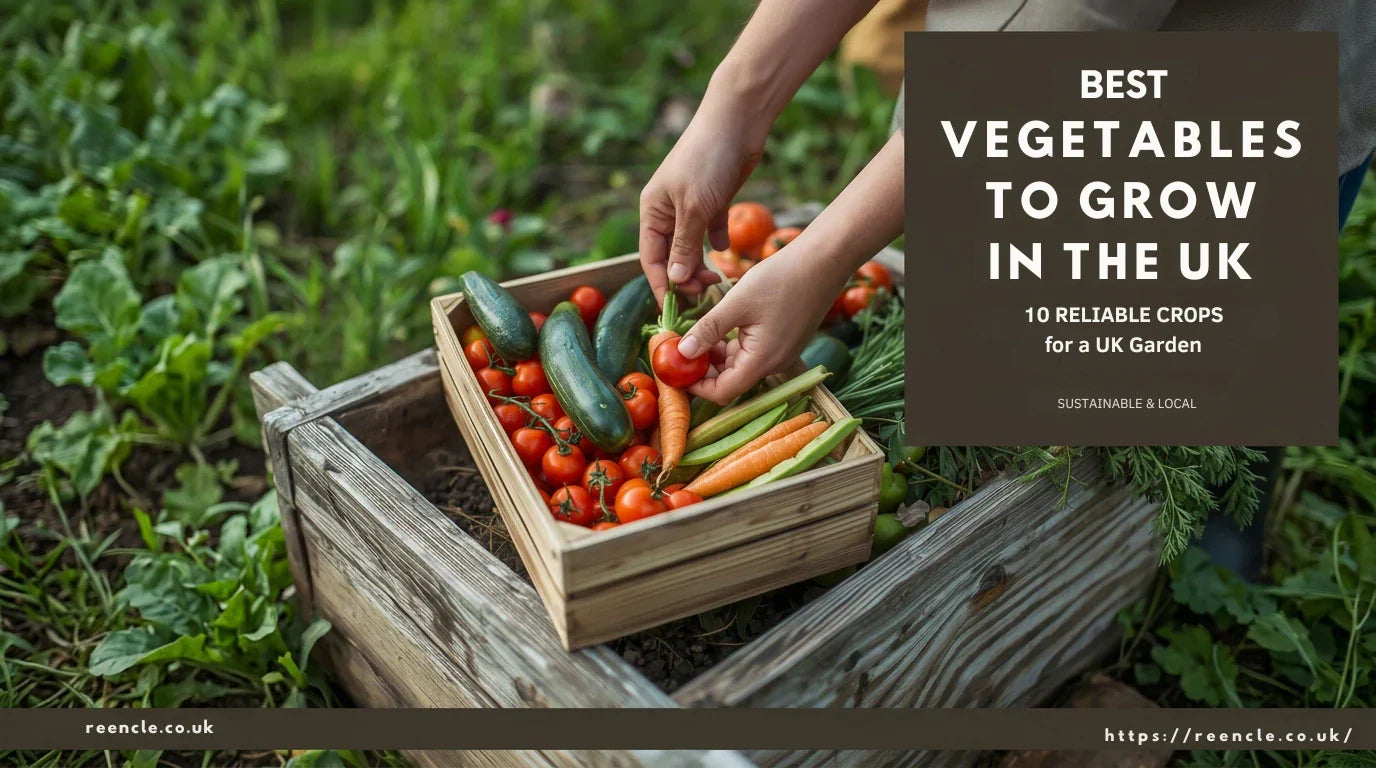
10 Vegetables That Actually Grow Well in the UK

Person's hands placing freshly harvested courgettes, tomatoes and carrots into a wooden trug on a garden raised bed.


      Home Gardening      

10 Vegetables That Actually Grow Well in the UK


Whether you have a full allotment, a raised bed, or a few pots on a balcony, these ten vegetables are well-suited to the UK climate and rewarding from the very first season.


By the Reencle Team


A productive UK kitchen garden with raised wooden beds growing courgettes, kale, tomatoes on canes, and lettuce in rows on a bright summer day.     

Growing your own vegetables cuts your shopping bill, puts better food on the table, and means you actually know what went into the ground. The UK's temperate climate suits a wider range of crops than most people assume. Cool, wet springs and mild summers are ideal conditions for many of the vegetables listed here.


You don't need a large garden. Several of these crops thrive in containers or raised beds. And you don't need to grow everything at once. Starting with two or three reliable vegetables and learning how your space behaves will get you further than planting twenty things and losing track of half of them.


These ten were chosen because they work: in UK conditions, for beginners, and in the kitchen.


Contents

     
        01: Courgettes         06: Beetroot         02: Tomatoes         07: Carrots         03: Potatoes         08: Broad Beans         04: Lettuce & Salad Leaves         09: Kale         05: Peas         10: Spring Onions         Quick Reference Table         Expert Insight         FAQ      


        Vegetable 01        

Courgettes


Courgettes are about as forgiving as vegetables get. Sow seeds indoors in April, pot them on once they have four true leaves, and move them outside after the last frost, typically late May. From that point, they need very little from you.        

One or two plants is plenty. Courgettes are prolific to the point of embarrassment. Check every couple of days once they start fruiting. Leave one for a week and you'll come back to a marrow. Pick at 15–20 cm and they taste far better than anything from a supermarket.


They grow well in large containers (at least 30 litres), in the ground, or in a raised bed. The big leaves shade the soil and keep weeds down.

       
          Key takeaway: Sow courgettes indoors in April, move outside after the last frost, and pick fruit at 15–20 cm for the best flavour.        


        Vegetable 02        

Tomatoes


Tomatoes ask more of you than courgettes. Worth it. Shop-bought tomatoes are picked underripe for transport. Homegrown ones, left on the vine, taste like a completely different vegetable.        

Start seeds indoors from late February to April, on a warm windowsill. Pot them on as they grow. By late May, move them into their final spot: a large container, grow bag, or greenhouse border. Once flowering starts, water consistently and add a weekly liquid feed. On cordon varieties, pinch out side shoots to push energy into the fruit.


In a typical UK summer, outdoor tomatoes do best in a sheltered, south-facing spot. Cherry varieties like 'Gardener's Delight' and 'Sungold' are more reliable outdoors than large beefsteak types. In a greenhouse or polytunnel, yields are significantly higher and the season extends into October.

       
          Key takeaway: Choose cherry varieties for outdoor growing, keep watering consistent, and feed weekly once the first flowers appear.        


        Vegetable 03        

Potatoes


Potatoes tolerate poor soil, suppress weeds as they grow, and produce a harvest even when things go wrong. Not many crops will do that.        

Start with seed potatoes rather than supermarket potatoes. Chit them: leave them in a light, cool place until short sprouts develop, from late January onwards. Plant first early varieties in March or April, around 30 cm apart and 12 cm deep. Early varieties like 'Charlotte' or 'Rocket' are ready in about 10–12 weeks and produce new potatoes with far better flavour than anything you'll buy.

hree-step flat design infographic showing how to chit potatoes: placing seed potatoes in an egg box on a bright windowsill, waiting for short green sprouts to develop, then planting sprout-side up in the ground.       

Maincrop varieties take longer but produce higher yields and store well. As they grow, mound soil up around the stems. This protects tubers from light and encourages more to form.

       
          Key takeaway: First early varieties are the best starting point. Faster to harvest and far tastier than anything you'll buy.        


        Vegetable 04        

Lettuce and Salad Leaves


Lettuce is one of the fastest and most space-efficient vegetables you can grow. Sow seeds directly into a pot, container, or border from March onwards, and you can be harvesting within six to eight weeks.        

The key to a continuous supply is succession sowing: sow a small row every two to three weeks rather than a whole packet at once. This avoids a glut followed by nothing. Cut-and-come-again varieties like 'Salad Bowl' or 'Lollo Rossa' let you harvest outer leaves while the plant keeps producing from the centre.


Lettuce handles partial shade well, so it works in spots that don't get much direct sun. It also bolts (goes to seed and turns bitter) in hot weather, so sow earlier in the season and again in late summer for an autumn harvest.

       
          Key takeaway: Sow small amounts every few weeks rather than a full row at once, and choose cut-and-come-again varieties for the longest harvest window.        


        Vegetable 05        

Peas


Peas grown at home taste nothing like frozen or tinned peas. They are sweet, crisp, and often eaten straight from the pod before they reach the kitchen. That alone makes them worth growing.        

Sow directly into the ground or a deep container from March to June. Peas tolerate cool weather and can go in earlier than most vegetables. They need something to climb: bamboo canes, a length of netting, or twiggy sticks pushed into the ground work well. Water during dry spells, particularly once flowering begins.


Pick pods as soon as they feel plump. Leaving pods on the plant signals it to stop producing, so keep harvesting and the plant keeps cropping. One packet of seed sown in succession will give you several weeks of picking.

       
          Key takeaway: Harvest pods regularly as soon as they fill out. The more you pick, the more the plant produces.        


        Vegetable 06        

Beetroot


Beetroot is almost entirely pest-resistant and grows well in most UK gardens without much intervention. One plant, two harvests: young leaves for salads, roots by late summer.        

Sow seeds directly into the ground from April onwards. Beetroot dislikes freshly manured soil, so prepare the bed with compost rather than fresh manure. Sow 2–3 cm apart, thin to around 10 cm once seedlings appear, and water in dry spells. Roots are typically ready in 8–10 weeks.


Don't leave beetroot in the ground too long. Roots that go past around 7 cm in diameter start to become woody. Don't pull them all at once, and store in a cool, dry place or in boxes of sand for several months.

       
          Key takeaway: Harvest beetroot at 5–7 cm diameter for the best texture, and sow in succession from April to July for a long season.        


        Vegetable 07        

Carrots


Carrots are satisfying to grow precisely because pulling one from the ground feels like a small discovery. The flavour of homegrown carrots, particularly when eaten young, is noticeably better than shop-bought.        

The main requirement is loose, stone-free soil. Stones and compacted ground cause forked or stunted roots. If your soil is heavy clay, grow a short, round variety like 'Parmex' or 'Paris Market' in a deep container or raised bed filled with free-draining compost. Sow directly from April to July, thinly in rows, and thin seedlings to 5–8 cm apart. Cover with fine mesh to protect against carrot fly.


Sow another short row every three to four weeks and you'll be harvesting from late June to October.

       
          Key takeaway: Loose, stone-free soil is the single most important factor. Container growing with good compost works well if your garden soil is heavy or full of clay.        


        Vegetable 08        

Broad Beans


Broad beans were made for UK weather. They thrive in cool conditions, tolerate frost, and can be sown in autumn (October to November) for an early summer harvest, or in late winter (February to March) for a summer crop. Autumn-sown plants tend to be more robust and crop earlier.        

Push seeds directly into the ground about 5 cm deep and 20 cm apart. They need support as they grow. A simple framework of canes and string prevents the stems flopping over in wind. Pinch out the growing tips once the first pods are visible; this deters blackfly and directs energy into the developing beans.


Harvest when the pods are plump but not bulging. Young broad beans eaten shortly after picking are sweet and tender. Left too long, they become mealy.

       
          Key takeaway: Autumn sowing gives the most reliable crop. Plants overwinter well and pod up earlier in the year.        


        Vegetable 09        

Kale


Kale is about as low-maintenance as vegetables get. Wind, frost, neglect: it shrugs all of it off. And it keeps cropping from autumn right through to spring, covering the hungry gap when everything else has packed up.        

Sow indoors from March to May, or directly outdoors from May to June. Transplant into their final position at 45 cm spacing. Kale needs little feeding beyond a good starting compost. Pick outer leaves as you need them, leaving the central growing point intact so the plant keeps producing.


'Cavolo Nero' (Tuscan kale) and 'Redbor' are reliable UK varieties. Tuscan kale in particular is expensive in supermarkets and almost effortless to grow at home.

       
          Key takeaway: Pick outer leaves regularly and leave the growing centre intact. One plant can produce harvests for six months or more.        


        Vegetable 10        

Spring Onions


Spring onions are the fastest vegetable on this list. From sowing to harvest takes as little as eight weeks, and they need almost no space. A window box or a single pot on a windowsill will do.        

Sow directly where they are to grow, from March through to August. No thinning, no transplanting, no support required. Water during dry spells. Cut at ground level when the tops reach around 15–20 cm, or pull the whole plant. Some varieties will re-sprout if cut above the base, giving a second harvest from the same sowing.


They work well as a gap-filler between slower-growing crops. Sow a short row every few weeks and you'll have a steady supply from May to October without much thought.

       
          Key takeaway: Sow a short row every three weeks from March onwards and you'll have a steady supply all season.        


Quick Reference


UK Vegetable Growing at a Glance


Vegetable Sow Harvest Notes
Courgette April (indoors) July–Sept Container 30L+. Easy.
Tomato Feb–April (indoors) July–October Grow bag or large pot. Medium.
Potato March–April June–October Large pot or ground. Easy.
Lettuce March–Sept May–October Any container. Easy.
Peas March–June June–August Deep container. Easy.
Beetroot April–July July–October Container-friendly. Easy.
Carrot April–July July–October Deep pot if soil is heavy. Easy–medium.
Broad Bean Oct–Nov or Feb–Mar June–July Needs open ground. Easy.
Kale March–June Sept–April Large container or ground. Easy.
Spring Onion March–August May–October Window box or any pot. Easy.
lat design sowing calendar showing when to sow and harvest ten UK vegetables including courgettes, tomatoes, potatoes, peas and kale across the months March to October.        
     
        Did You Know        

What Growing Your Own Actually Does for Your Household


Flavour is only part of it. A study from the University of Sheffield followed household food-growers over the course of a full year and found that those who grew their own fruit and vegetables ate 70% more fruit and vegetables than the UK national average. They also produced fruit and vegetable waste 95% lower than the average UK household.        

Growing your own changes how you relate to food. You harvest what you need and use it the same day. The waste just doesn't happen. Supermarket produce is picked early, travels hundreds of miles, and arrives already counting down. Homegrown goes from soil to kitchen the same day.

Stat infographic showing that households who grow their own produce 95 per cent less fruit and vegetable waste than the average UK household, illustrated with rows of apple icons where most are green and one is greyed out.       

The same study found that household food-growers were able to produce around half of their annual vegetable supply at home, without a large plot. Even a small space, looked after properly, changes what your household spends and wastes.


FAQ


Common Questions


What is the easiest vegetable to grow in the UK for beginners?


Courgettes and lettuce are the most reliable for beginners. Courgettes are highly forgiving, produce heavily, and tolerate mistakes well. Lettuce grows fast, can be harvested within six to eight weeks of sowing, and does well in pots or small beds with minimal care.


What vegetables grow well in pots in the UK?


Tomatoes, lettuce, spring onions, beetroot, peas, and kale all grow well in containers. Tomatoes do best in grow bags or pots of at least 20 litres. Courgettes need a container of at least 30 litres. Carrots grow well in deep pots filled with loose, gritty compost.


When should I start growing vegetables in the UK?


Most vegetables are started between March and May. Broad beans can go in as early as October for an early summer harvest. Tomatoes and courgettes are started indoors in late February to April and moved outside after the last frost, usually late May. Lettuce and spring onions can be sown directly outdoors from March.


Can I grow vegetables in a small UK garden?


Yes. Lettuce, spring onions, tomatoes, and kale all thrive in pots, window boxes, or small raised beds. You don't need a large plot. A few well-chosen crops grown in containers can supply a household with regular harvests from May through October.


What vegetables can I grow through winter in the UK?


Kale is the most reliable winter crop in the UK and can be harvested from September through to April. Purple sprouting broccoli, leeks, and chard also tolerate UK winters well. Broad beans sown in October will overwinter and produce pods in late spring.


What should I do with vegetable scraps and peelings from homegrown produce?


Composting is the best option. Carrot tops, potato peelings, courgette ends, pea pods, beetroot skins, and outer kale leaves all break down well. A countertop food waste composter like the Reencle processes these scraps quickly and produces ready-to-use compost that can go straight back into the same beds your vegetables grew from.


🌱


The bottom line


Growing your own vegetables is one of the simplest ways to eat better, spend less, and produce far less food waste throughout the year. Start with two or three crops, learn your space, and go from there.


And the scraps? Every vegetable on this list generates prep waste the moment you harvest and cook: potato peelings, courgette ends, tomato cores and skins, pea pods, carrot tops, kale stalks, outer lettuce leaves, and beetroot skins. Without a plan, all of it goes to landfill. The Reencle food waste composter processes vegetable scraps, cooked food, and even meat and dairy scraps that a traditional compost bin won't accept. It produces ready-to-use compost in as little as 24 hours. That compost goes straight back into the beds your vegetables came from, closing the loop completely.

        Turn Your Kitchen Scraps into Garden Compost →      


Reading next

From Kitchen to Garden: How Reencle Compost Transforms Your Plants 🌱
Person's hands moving a half-used vegetable into a clear airtight container on a white kitchen counter with fresh produce nearby.

Leave a comment

This site is protected by hCaptcha and the hCaptcha Privacy Policy and Terms of Service apply.