
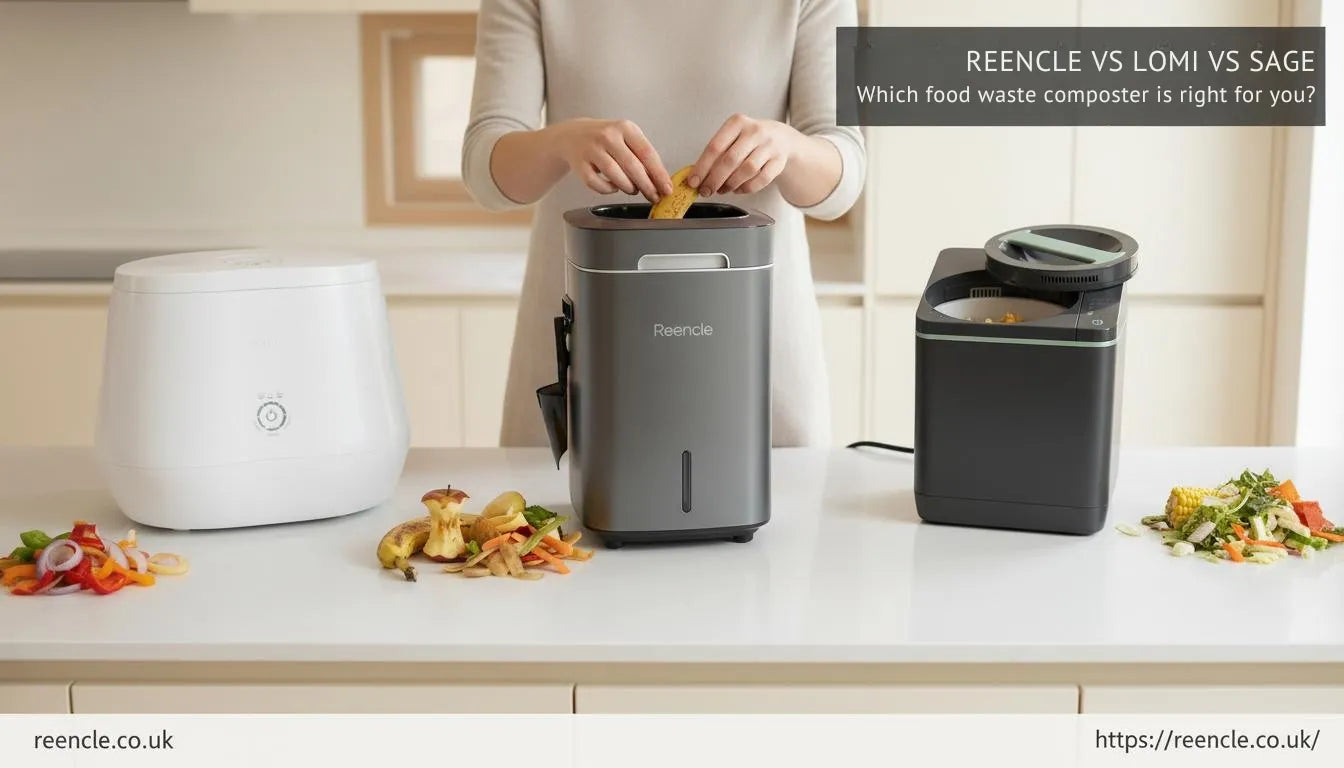
Reencle vs Lomi vs Sage: Which Food Waste Composter Is Best for You?
Three of the most popular electric composters in the UK, compared on what actually matters: output quality, running costs, noise, and daily usability.
 Reencle, Lomi, and the Sage FoodCycler are the three electric composters you'll see most often in the UK. They all promise to deal with food waste at home. They all sit on or near your kitchen worktop. And they all cost several hundred pounds.
They don't all work the same way, though. Two of them are food dehydrators. One uses live microbes to produce actual compost. That difference shapes everything: what comes out the other end, what it costs to run long-term, and whether the output is safe for your plants.
Here's how the three compare when you look past the marketing.
Contents
How Each Machine Works
These three machines fall into two camps, and knowing which is which matters more than any other spec.
Reencle Prime uses a colony of live aerobic microorganisms called ReencleMicrobe. You add food scraps, close the lid, and the microbes break the waste down biologically. It runs continuously. No cycles to start, no cycles to wait for. You can open the lid and toss in more scraps whenever you like.
Lomi uses heat and mechanical grinding. You load the bucket, pick a mode (Eco or Grow), press start, and wait. Eco mode runs about 4 hours. Grow mode, which uses optional LomiPods containing microbial additives, takes 16 to 20 hours. You can't add food mid-cycle.
The Sage FoodCycler runs on the same dehydrate-and-grind principle. Load the 2-litre bucket, press the button, and it dries, grinds, and cools your scraps over 4 to 8 hours depending on moisture content. Same limitation: no adding food while it's running.
What Comes Out the Other End
This is the part most comparison posts gloss over. What comes out of each machine is not the same thing, and the difference matters if you plan to use the output.
Reencle's output is biologically decomposed material. Independent laboratory testing at Penn State University rated it 2.2 to 2.4 on a compost stability scale, placing it very close to mature compost. After a 30-day curing period in soil or a container, it works as a genuine soil amendment for garden beds, raised planters, houseplants, or balcony pots.
Lomi's Eco mode produces dehydrated, ground food scraps. It looks like dark soil, but it hasn't been composted. Add it directly to plants and you risk nitrogen lock, mould, or a wave of smell as the material starts to decompose. Grow mode with LomiPods introduces some microbial activity, though independent reviewers note the results vary and the pods push up costs.
The Sage FoodCycler produces what Sage calls EcoChips: sterile, dehydrated particles at about 20% of the original volume. Not compost. Sage recommends mixing them into soil and waiting several weeks before they do plants any good. Straight onto a flower bed, they carry the same nitrogen-lock and mould risks.
If you garden, this distinction is the one that should drive your decision. Reencle's output works in soil. The other two need weeks of breakdown before they're useful.
Running Costs Over One and Two Years
The sticker price is what you pay once. Running costs are what you keep paying.
Reencle Prime costs £399 to £425 depending on promotions. It draws 1.25 kWh per day, roughly £9 per month at the UK average rate of £0.24/kWh. The included carbon filter lasts 1 to 2 years. No pods, no accelerants, nothing to reorder. A replacement filter costs around £30.
The Sage FoodCycler costs £370 to £420. Each cycle uses about 1 kWh. Two cycles a week works out to roughly £2 per month in electricity. But the carbon filters need swapping every 3 to 4 months at £39.95 per set. That's £120 to £160 a year just in filters.
Lomi runs £295 to £399 depending on the retailer. Electricity is similar to Sage at about £2 per month for two weekly cycles. Filters cost £24 to £30 each and need replacing every few months. LomiPods (needed for Grow mode) add roughly £0.40 per cycle, or about £3.30 a month.
Year 1 Estimates
- Reencle £399 purchase + ~£108 electricity = ~£507
- Lomi £399 purchase + ~£24 electricity + ~£80 filters + ~£40 pods = ~£543
- Sage £420 purchase + ~£24 electricity + ~£120 filters = ~£564
Year 2 Estimates (Running Costs Only)
- Reencle ~£108 electricity + £30 filter = ~£138
- Lomi ~£24 electricity + ~£80 filters + ~£40 pods = ~£144
- Sage ~£24 electricity + ~£120 filters = ~£144
Two-Year Totals
- Reencle ~£645
- Lomi ~£687
- Sage ~£708
The gap keeps growing after Year 2 because Reencle's recurring costs are almost entirely electricity.
Capacity and Daily Usability
Specs matter less than how the machine fits your actual cooking routine.
Reencle Prime has a 14-litre chamber and handles up to 1kg of food waste per day. Because it runs continuously, you just add scraps as they happen. Plates after breakfast, banana peels at lunch, dinner trimmings in the evening. You empty the compost every 1 to 3 months. Open lid, add scraps, close lid. That's the entire routine.
Lomi holds 3 litres per cycle. Fill the bucket, start a cycle, wait 4 to 20 hours. You can't add anything while it runs. Once it finishes, empty, refill, go again. If your household cooks multiple meals a day, you'll need somewhere to stash scraps while the machine is mid-cycle.
Sage holds 2 litres. Same batch constraint, smaller bucket. Larger households may need to run it daily or twice daily to keep up, and you're still locked out during each cycle.
For one or two people, Lomi or Sage can probably keep pace. A family of three or more cooking daily will hit the batch ceiling quickly. That's where continuous operation makes a real difference.
Noise and Kitchen Fit
If it's in your kitchen, you'll hear it. The question is how much.
Reencle Prime runs at under 28dB. Quieter than a whisper. Most owners say they forget it's on. There's a faint hum from the internal stirring, but nothing that cuts through conversation or bothers anyone sleeping nearby.
Lomi is louder during its cycle. The motor and grinding produce sounds somewhere around food-processor-at-low-speed territory. Not dramatic, but noticeable. Most people run it overnight or while they're out of the house.
The Sage FoodCycler is the loudest of the three during its grind stage. Sage itself compares it to a dishwasher. The drying and cooling phases are quieter, but the grind phase is hard to ignore. Again, best run when you're not using the kitchen.
All three fit on a worktop, though Reencle is the tallest at 46.7cm. Lomi takes up the least counter space. Sage sits between the two. If your worktop is crowded, Reencle can also go on the floor beside a cupboard. You only open it a few times a day.
What Can and Can't Go In
All three take fruit and veg scraps, bread, coffee grounds, tea bags (minus the staple), rice, pasta, and cereal. The differences appear with trickier waste.
Reencle takes meat, poultry, fish, dairy, cooked food, eggs, and small soft bones. All of it goes in with everything else, any time, no special mode. The microbes handle protein-heavy waste the same way they handle vegetable peelings. The carbon filter deals with the smell.
Lomi handles meat and dairy, but works best in Grow mode (the longer 16 to 20 hour cycle) for heavier protein loads. Large amounts of meat or oily food in Eco mode can leave the output smelling off. LomiPods help, but they add to the cost.
Sage can process small amounts of meat and dairy, but advises against large quantities. High-fat foods cause odour issues during the cycle, and the dehydrated output is more likely to attract pests if you don't dispose of it carefully.
None of the three should receive large hard bones, fruit pits, cooking oil in quantity, or non-food items.
The real-world test: you cook a roast chicken on Sunday. Monday morning, the carcass, skin, and leftover gravy need to go somewhere. Reencle handles it without a thought. With Lomi, you'd need a longer Grow cycle. With Sage, that chicken waste is probably going in your council bin.
Quick Reference
Reencle vs Lomi vs Sage at a Glance
| Feature | Reencle Prime | Lomi | Sage FoodCycler |
|---|---|---|---|
| UK Price | £399–£425 | £295–£399 | £370–£420 |
| Processing Method | Microbial composting | Dehydrator | Dehydrator |
| Capacity | 14L (up to 1kg/day) | 3L per cycle | 2L per cycle |
| Cycle Type | Continuous | Batch (4–20 hrs) | Batch (4–8 hrs) |
| Noise Level | Under 28dB | Noticeable grinding | Dishwasher-level |
| Output | Stable compost | Dried scraps | Dried EcoChips |
| Plant-Safe? | After 30-day cure | Weeks of curing | Weeks of curing |
| Meat & Dairy | Yes, continuously | Grow mode only | Limited |
| Filter Cost/Year | ~£15–£30 | ~£75–£90 | ~£120–£160 |
| Consumables | None | LomiPods (~£0.40/cycle) | None |
| Electricity/Month | ~£9 | ~£2 | ~£2 |
| Est. Year 1 Total | ~£507 | ~£543 | ~£564 |
| Est. Year 2 Total | ~£645 | ~£687 | ~£708 |
UK Food Waste Collections Are Changing. Does That Affect Your Choice?
From March 2026, 85% of households in England are required to have weekly separate food waste collections under the Simpler Recycling reforms. Scotland and Wales already have similar schemes running.
On paper, that means more of your food waste gets collected by the council. In practice, the caddy still sits under your sink or on your worktop. It still smells between collections. It still pulls in fruit flies the moment the weather warms up. And everything you put in it goes to industrial processing rather than coming back as something useful for your garden.
UK households throw away 6 million tonnes of food every year, 4.4 million tonnes of which was perfectly edible. That costs families a collective £17 billion. The average household loses around £470 a year to food that ends up in the bin.
An electric composter won't eliminate food waste entirely. But it turns whatever waste you do produce into something more useful than a bag of slop on the kerb. Whether you pick a dehydrator or a microbial composter depends on whether your goal is reducing volume or creating compost.
FAQ
Common Questions
Does Lomi actually make compost?
Not in the traditional sense. Lomi uses heat and grinding to dehydrate food scraps into a soil-like material. The output hasn't been biologically composted. Grow mode with LomiPods introduces some microbial activity, but independent reviewers note the results are inconsistent and the pods add ongoing cost.
Is the Sage FoodCycler output safe for plants?
Sage's EcoChips are dehydrated and sterile, not composted. They need to be mixed into soil and left for several weeks before they benefit plants. Adding them directly to pots or beds can cause nitrogen lock or mould as the material begins to decompose.
How much does it cost to run an electric composter in the UK?
Reencle costs roughly £9 per month in electricity because it runs continuously. Lomi and Sage cost less per cycle but need regular filter replacements and, for Lomi, optional pods. Over a full year, Reencle's total running cost is typically the lowest of the three.
Can I put meat and cooked food in these machines?
Reencle handles meat, dairy, and cooked food continuously with no special mode. Lomi accepts them but works best in its longer Grow cycle for heavier loads. Sage recommends limiting meat and dairy to small amounts to avoid odour issues.
Which electric composter is the quietest?
Reencle runs at under 28dB, quieter than a library. Lomi and Sage both produce noticeable grinding noise during their active cycles, with Sage being the loudest during its grind phase.
Do I still need my council food waste bin if I have one of these?
You can keep it for overflow or items your machine doesn't take, like large bones or cooking oil. Most people find they barely fill their council caddy once they're composting daily. Having both means nothing edible has to go in your general waste.
The bottom line
All three machines reduce the amount of food waste leaving your kitchen. The difference is what they do with it.
And the scraps? If what matters to you is turning leftover curry, chicken bones, and Sunday roast scraps into something your garden can actually use, that's where microbial composting pulls ahead. Instead of drying scraps into powder that needs weeks of curing, a Reencle breaks them down biologically into compost you can add straight to pots, beds, or borders. No pods, no waiting for a cycle to finish, no guessing whether the output is plant-safe.
See How Reencle Works →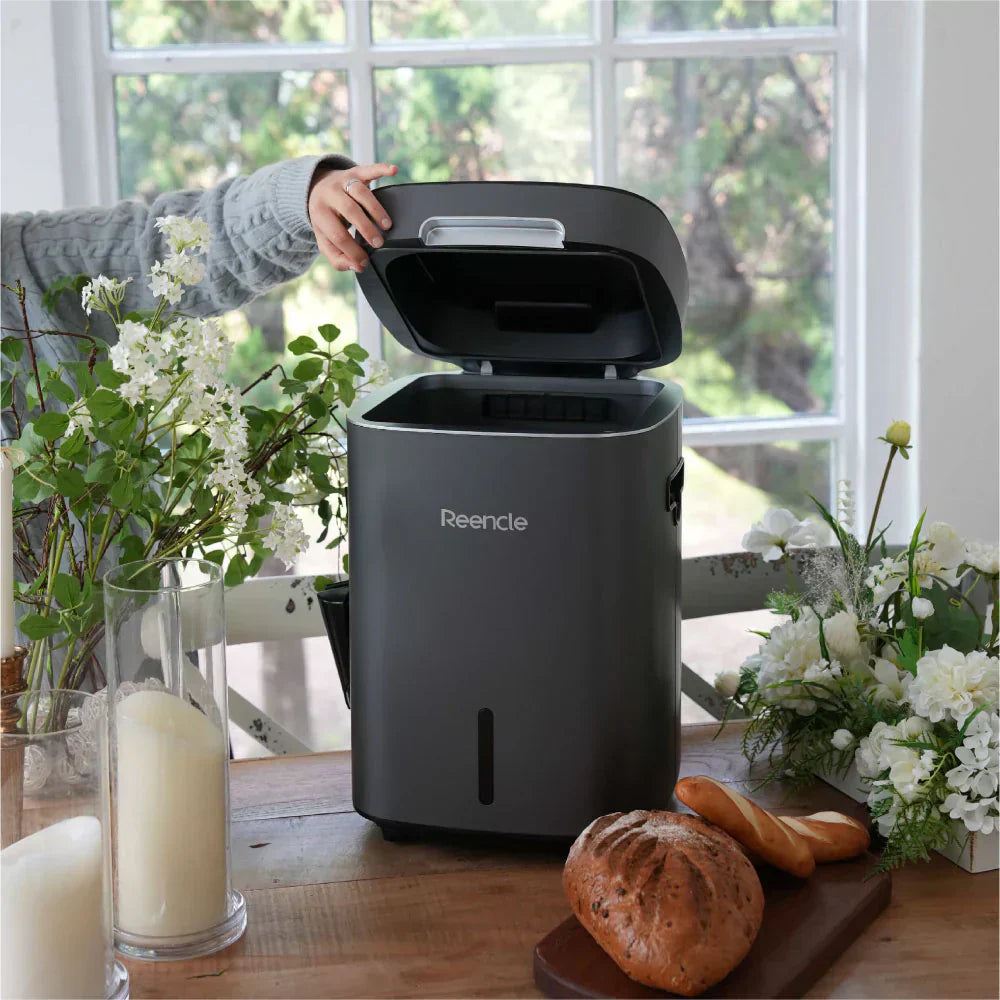


Leave a comment
This site is protected by hCaptcha and the hCaptcha Privacy Policy and Terms of Service apply.