
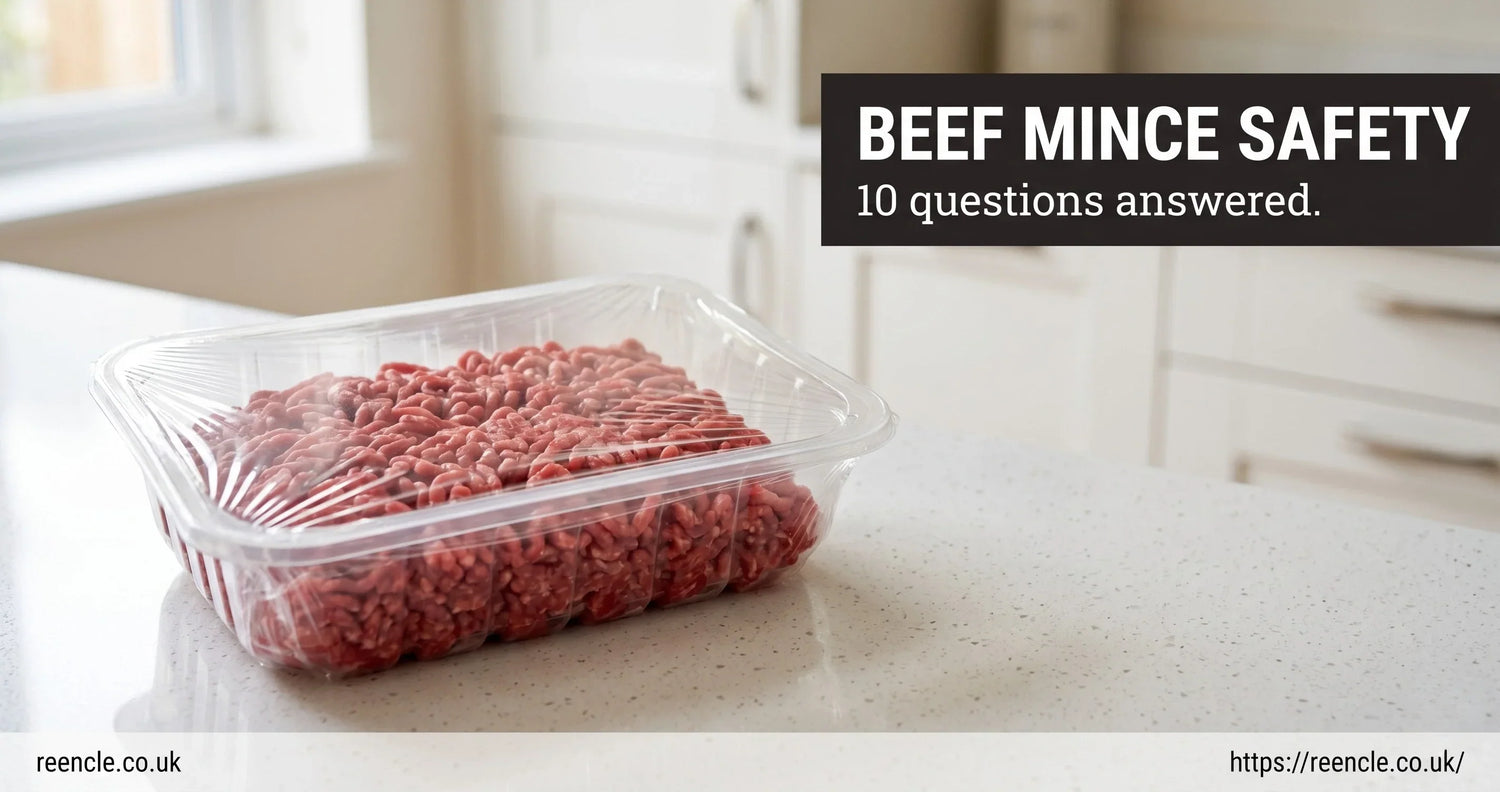
Beef Mince Safety: 10 Questions Answered

Raw beef mince in a supermarket tray on a bright kitchen counter, with text overlay reading 'Beef Mince Safety — 10 questions answered.

Food Safety

Beef Mince Safety: 10 Questions Answered


Raw beef mince spoils faster than any other protein you'll buy. One to two days in the fridge is all you get — here's why, and what to do about it.

Raw beef mince spoils faster than any other protein you'll buy. One to two days in the fridge is all you get. This short window frustrates home cooks who expect a few extra days of flexibility. The reason is simple: mincing distributes surface bacteria throughout the entire product. A steak's surface bacteria stays mostly on the surface. Mince bacteria is everywhere. Understanding the why makes the rules stick.Raw beef mince in a supermarket tray with cling film on a wooden cutting board with refrigerator visible in background


Contents

Why Mince Only Lasts 1–2 Days Use-By Date vs Storage Timeline Surface Area and Spoilage What Temperature Kills E. coli How to Tell If Mince Has Gone Off What Brown Mince Actually Means How Long Cooked Mince Lasts How Long to Freeze Raw Mince Can You Refreeze Thawed Mince Safest Way to Thaw Mince
Q01

Why Does Raw Beef Mince Only Last 1–2 Days?

Mincing changes everything. A whole steak has bacteria mostly on its surface. The interior is generally sterile. When beef is minced, that contaminated surface gets mixed throughout the entire batch. What was a surface problem becomes a whole-product problem.

Mincing equipment is another factor. Despite sanitation protocols, the equipment that processes hundreds of kilograms of meat is a contamination point.

The window: 1–2 days in the fridge at 5°C or below.
Q02

Is the Use-By Date the Same as Your Storage Timeline?

No. The use-by date is the FSA-mandated safety deadline — but it assumes the meat has been stored correctly from the point of purchase. Mince bought the day before its use-by date still needs to be used or frozen within 1–2 days from purchase, and only if it has been refrigerated correctly throughout.

If you buy mince that was already near the end of its shelf life in the supermarket, your window at home might be only a few hours.
Q03

How Does Mincing Surface Area Affect Spoilage?

Mincing creates enormous surface area. More surface area means more oxygen exposure, which drives both oxidation (colour changes) and bacterial growth. A chunk of beef has a few square centimetres of surface. Mince might have hundreds of square metres of total surface area when you account for all those tiny particles.

  • More surface area → more oxygen exposure
  • More oxygen exposure → faster bacterial growth
  • Faster bacterial growth → shorter safe window
Q04

What Temperature Kills E. coli in Beef Mince?

The FSA recommends cooking beef mince to a core temperature of 75°C. For whole steaks, the safe temperature is lower because bacteria stays on the surface. Mince needs the higher temperature because mincing can distribute bacteria throughout the interior of a burger or meatball.

Always use a food thermometer. Colour is unreliable — a burger can look done on the outside and be undercooked inside. The FSA also advises checking that there is no pink in the middle as a secondary visual check, but a thermometer is the only reliable method.
ood thermometer inserted into a pink burger patty displaying 75°C with safe temperature zone highlighted

FSA safe temp for mince: 75°C core temperature, no pink in the middle.
Q05

How Do You Tell If Beef Mince Has Gone Off?

Smell and texture are your indicators. Colour alone is not reliable.

  • Sour or ammonia-like smell: Definitive spoilage. Discard immediately.
  • Slimy or sticky surface: Bacterial growth. Discard.
  • Grey-brown colour + off-odour: Spoilage. Discard.
  • Bright red outside, brown inside: Normal. Not spoilage.
Never rely on colour alone. Time in the fridge is your most reliable indicator.
Q06

What Does Brown Beef Mince Actually Mean?

Bright red on the surface and brown in the centre is normal, not spoilage. The bright red comes from oxymyoglobin — the form of the oxygen-carrying protein myoglobin when it's exposed to air. The brown interior is metmyoglobin — the deoxygenated form that develops when oxygen isn't present.

Supermarkets use modified atmosphere packaging to keep the surface red. Both colours indicate normal, fresh beef. What matters is whether the mince is within 1–2 days of purchase and has been stored correctly.

Flat design cross-section showing red exterior (oxymyoglobin with oxygen) versus brown interior (deoxygenated myoglobin)

Red outside + brown inside = normal. Grey-brown throughout + smell = spoilage.
Q07

How Long Does Cooked Beef Mince Last?

3–4 days in the fridge in an airtight container. Let it cool to near room temperature before sealing to minimise condensation. Don't leave cooked mince at room temperature for more than 2 hours — the FSA recommends discarding anything left out beyond that window.

Cooked mince: 3–4 days in the fridge. Maximum 2 hours at room temperature.
Q08

How Long Can You Freeze Raw Beef Mince?

3–4 months at -18°C for best quality. Cooked mince lasts 2–3 months. Freeze on the day of purchase if you're not using it within 1–2 days. Portion into meal-sized amounts before freezing.

For storage beyond 2 months, repackage in heavy-duty freezer bags or vacuum-seal. The original supermarket packaging lets air through and causes freezer burn over time.

  • Raw mince (frozen)3–4 months at -18°C
  • Cooked mince (frozen)2–3 months at -18°C
Q09

Can You Refreeze Beef Mince That's Been Thawed?

Beef mince thawed in the refrigerator can be refrozen with some quality loss. Do not refreeze mince that was thawed in cold water or the microwave — cook it first if you want to freeze it again.

  • Thawed in fridge: Can refreeze, with some quality loss.
  • Thawed in cold water or microwave: Cook first, then freeze.
  • Thawed at room temperature: Never do this. Discard if this happened.
Q10

What's the Safest Way to Thaw Frozen Beef Mince?

  • Fridge thawing (best): Move mince to the fridge 12–24 hours before you need it. Use within 1–2 days of thawing.
  • Cold water thawing: Seal the meat, submerge in cold water, and change the water every 30 minutes. A 500g portion thaws in about 1 hour. Cook immediately after.
  • Microwave thawing: Use only if cooking immediately. Microwaving partially cooks the outer edges, creating uneven temperatures that allow bacterial growth.
Never thaw at room temperature. The outer portion enters the danger zone while the interior is still frozen.
FSA Guidance

Should Beef Mince Be On the Bottom Shelf?

Yes, always. The FSA specifically advises storing raw meat on the bottom shelf of the fridge, below cooked foods and ready-to-eat produce. If the package leaks, raw meat juices won't drip onto other foods.

Bottom shelf, below cooked foods. Always. FSA requirement, not a suggestion.

Quick Reference

Mince Safety at a Glance


Situation Guideline
Raw mince in fridge 1–2 days
Cooked mince in fridge 3–4 days
Raw mince in freezer 3–4 months
Cooked mince in freezer 2–3 months
Safe internal temp 75°C
Max time out of fridge 2 hours
Expert Insight

When the Numbers Make It Real

The link between beef mince and serious illness in the UK is well documented. In the summer of 2023, the UK Health Security Agency identified an outbreak of Shiga toxin-producing E. coli (STEC) — a rare strain — that resulted in 27 confirmed cases across England, Scotland, Wales, and Northern Ireland. Cases ranged in age from six months to 74 years, with almost half confirmed in children aged nine and under. Of those who provided a food history, every single one reported eating beef burgers, beef mince prepared at home, or other beef mince products.

The concern with STEC isn't just gastric discomfort. In severe cases, the toxins damage the lining of small blood vessels, causing red blood cells to break down and leading to kidney failure — a condition called haemolytic uraemic syndrome (HUS). Children under five are at highest risk, and HUS can cause permanent kidney damage or death.

STEC cases in England rose 26% in 2024, reaching 2,544 confirmed cases — and beef was identified as the source of one of the five national outbreaks that year. The FSA is unambiguous on the fix: all minced beef products must reach 75°C throughout. A thermometer isn't optional — it's the only way to know.

Sources: UK Health Security Agency (UKHSA) annual STEC data 2024; Microbial Genomics outbreak investigation report, June 2024.

FAQ

Common Questions


My mince looks bright red but I bought it 3 days ago. Is it still okay?

No. Time is the deciding factor, not colour. Bright red means nothing about freshness after the 1–2 day window. Discard it. Red colour can last well beyond the safe storage window due to modified atmosphere packaging.

There's a slight sour smell but no visible mould. Should I cook it?

No. A sour smell is definitive spoilage. Don't cook it, don't taste it. Discard. The bacteria causing the smell can cause serious foodborne illness.

How do I know my fridge is actually 5°C?

Use a standalone fridge thermometer. Many fridges don't maintain consistent temperature. If yours is warmer than 5°C, the 1–2 day window is shorter than the guideline.

Can I store mince in the original packaging in the fridge?

Yes, if using within 1–2 days. For leakage protection, place it in a second container or bag on the bottom shelf.

What happens if mince sits at room temperature for 3 hours?

Once it exceeds 2 hours at room temperature, bacteria have multiplied into the danger zone. Discard it. Cooking won't make it safe if heat-stable toxins have already formed.

🥩

The bottom line

Mince's 1–2 day window isn't a suggestion. Freeze on purchase day if you're not cooking within that window. Use a food thermometer — never rely on colour. Bottom shelf, always.

And the scraps? Packaging, trimmings, and food waste don't have to go straight in the bin. A food waste composter turns organic waste into something useful instead.

Explore the Reencle Composter →


Reading next

Cooked chicken on a white plate with a kitchen thermometer on a bright kitchen counter, with text overlay reading 'The FSA Danger Zone — What happens to food between 8°C and 63°C.
Fresh broccoli head on a bright kitchen counter beside a glass jar of water, with text overlay reading 'Broccoli Storage — 7 ways to make it last longer

Leave a comment

This site is protected by hCaptcha and the hCaptcha Privacy Policy and Terms of Service apply.