
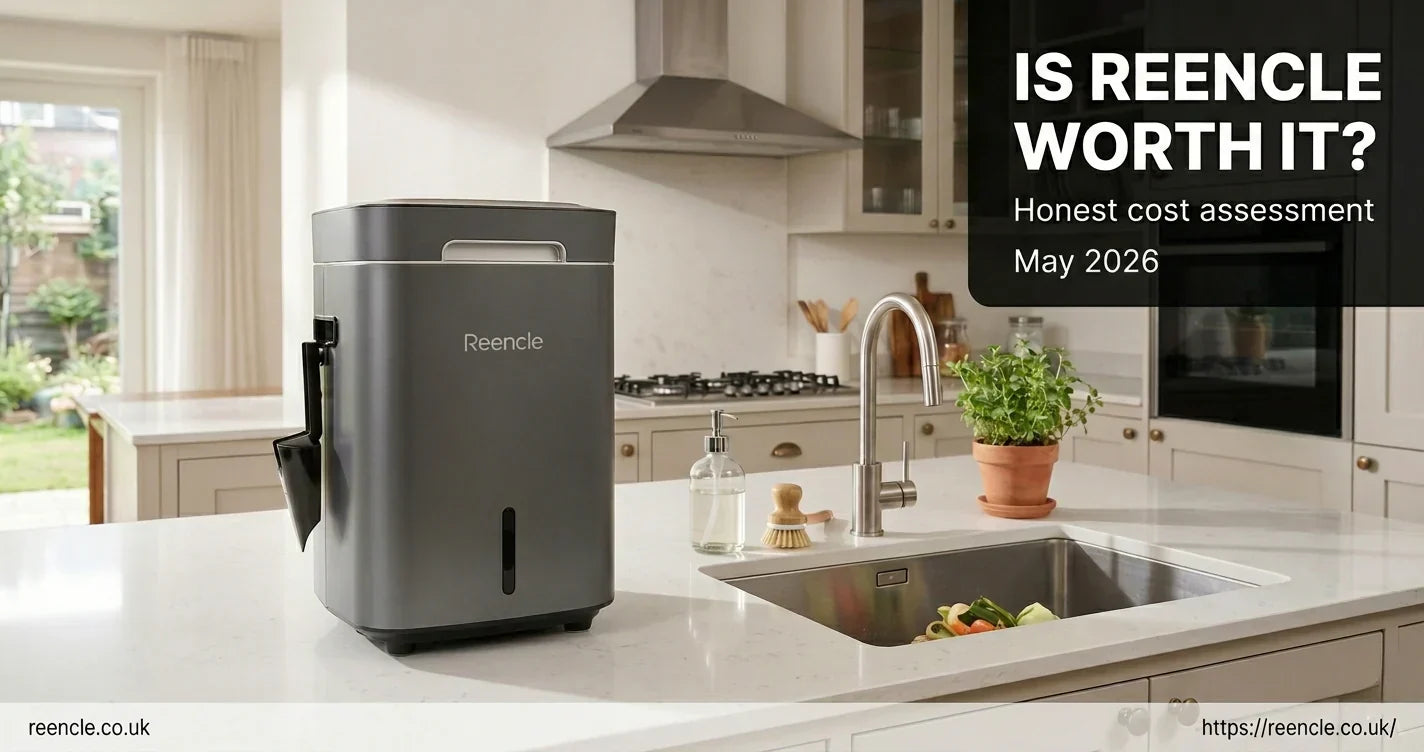
Is Reencle Worth the Money? Honest Assessment
 The Reencle costs £425. That is a serious amount of money for a kitchen appliance. Here is a clear-eyed breakdown of what you actually get — and whether it makes sense for your household.
Most reviews of the Reencle either love it unconditionally or dismiss it on price alone. Neither is much use if you are trying to decide whether to spend £425.
Here is the honest version. The full cost — not just the sticker price. A comparison against every realistic alternative. The real pros and real cons. And a plain answer to who it is right for, and who it is not.
One figure worth knowing before you start: UK households waste an average of £470 worth of food every year. That reframes the question. Is Reencle worth the money is not just about the machine. It is about what food waste is already costing you.
By the Reencle Team
Contents
What Does Reencle Actually Cost?
The headline price is £425 for the Reencle Prime. That is day one. The honest cost calculation includes everything you spend after that.
- Electricity: Approximately 1.25 kWh per day (52W motor). Roughly £110 per year running continuously at current UK rates. Running it 2–4 hours a day brings that down.
- Filters: Carbon filter around £35, mesh filter around £12 — both replaced every 9–12 months. Budget roughly £47 per year.
- Microbe refills: The live bacteria culture needs topping up once or twice a year. Allow £20–£35 per refill.
- Total Year 1: Approximately £595–£650 (purchase + first year running costs).
- Year 2 onwards: Approximately £150–£190 per year — roughly £12–£16 per month.
That is what you are actually committing to. After Year 1, the running cost is modest - roughly the same as a mid-range streaming service.

How Reencle Compares to the Alternatives
Reencle is not the only option. Before deciding whether it is worth it, here is what everything else actually offers.
Council food caddy
Cost: free. Your council collects it weekly. As of March 2026, all UK councils must offer separate food waste collection by law. Zero effort, zero cost. The downside: the waste leaves your home entirely. You get nothing back from it.
Traditional garden compost bin
Upfront cost: £20–£40 (many councils offer subsidised bins). Annual running cost: effectively nothing. What it cannot handle: meat, fish, dairy, cooked food, anything processed. What it needs: outdoor space, occasional turning, and 6–12 months before the compost is usable. For raw vegetable and garden waste only. Not sure which composting method suits your home?
Bokashi system
Upfront cost: approximately £60 for a two-bin starter kit. Annual ongoing cost: approximately £24 in bokashi bran. It handles all food types including meat and dairy — the same range as Reencle. What it produces: a fermented pre-compost that must be buried in soil or a compost heap to finish. It also has a sharp smell when you open the lid.
Reencle
Upfront cost: £425. Annual running cost: £150–£190. Handles everything continuously, with no batch processing. Produces nitrogen-rich compost output with 2–4 weeks of outdoor curing before garden use.

The Real Pros of Reencle
These are the genuine strengths, based on independent testing and verified user accounts.
- Takes everything. Meat scraps, fish skin, dairy, cooked leftovers, pasta, bread, raw vegetables — all of it. Traditional compost bins cannot handle this. Bokashi can, but needs more steps.
- Runs continuously. No batch system, no waiting for a cycle to finish, no emptying schedule. You add waste as you generate it.
- Genuinely quiet. At 52 watts with a slow-turning paddle, it is far quieter than most kitchen appliances. Running it overnight is not a problem for most households.
- Real compost output. Unlike dehydrator-based competitors such as Lomi and some FoodCycler models - which dry and shrink food waste rather than compost it - the Reencle uses live microorganisms actually to decompose waste. Independent testing has found high nitrogen and organic matter content, good germination rates, and low sodium.
- Odour-free when balanced. The triple-filter system handles the majority of smells when the microbe culture is healthy. Most users with a properly maintained machine report nothing detectable.
- Countertop-sized. No outdoor space needed for the unit. Kitchen worktop, utility room shelf, or garage bench all work.
The Real Cons of Reencle
Worth knowing before you buy.
- The price. £425 is real money. It is not unreasonable given what the technology does, but it is a significant upfront commitment. There is no point pretending otherwise.
- Compost needs curing. Output from the drum is not ready for plants straight away. It needs 2–4 weeks of outdoor maturation in a pot, compost heap, or garden bed before use. Some buyers are caught out by this.
- Microbe culture needs some care. The bacteria are inhibited by cleaning products in the drum, large bones, excess citrus peel, and alcohol residues. Not difficult to manage, but it does require attention.
- Paddle breakage reported. Tends to happen when the machine runs too dry. Waste should feel like wrung-out compost, not dry crumbs. Keeping moisture right prevents it.
- Vinegar smell possible. Too much bread or sweet waste at once can tip the microbe balance and produce a sharp smell when you open the lid. Coffee grounds or dry rice bran typically correct it within a few days. A known quirk, not a defect.
- Output needs somewhere to go. This is the hard limit. No balcony, no allotment, no garden — you are producing compost with nowhere to put it. The Reencle's core benefit disappears without an outlet. If you want to understand composting in small spaces, that guide covers flat and balcony options in detail.
Who Is Reencle Right For?
You will get genuine value from the Reencle if most of these apply.

- You have a garden, allotment, or outdoor planters. The compost output needs somewhere to go. Even a few large pots on a balcony work, but the output must have a destination.
- You generate significant food waste daily. Families cooking from scratch, households with children, anyone regularly producing leftovers, prep trimmings, and scraps will keep the Reencle busy. The more waste you generate, the better the value becomes.
- You want a set-and-forget system. Lower maintenance than bokashi, lower effort than traditional composting. If you want composting that runs in the background, this is the best available option.
- You have tried a traditional bin and found it insufficient. Most UK households generate a lot of meat, dairy, and cooked food waste. A traditional bin only handles a fraction of that.
Who Should Probably Skip It
Reencle is not right for every household. Here are the situations where another option makes more sense.

- You live in a flat with no outdoor space. Without somewhere for the finished compost to go, the output becomes a problem. The council caddy is free and does the job without asking anything of you.
- Your household generates very little food waste. Single-person households or couples who rarely cook and produce minimal scraps will find the cost per unit of waste processed difficult to justify.
- You want the cheapest option. Bokashi handles all the same food types at a fraction of the cost. It is more hands-on, but it works. If budget is the main concern, bokashi is the honest recommendation.
- You would rather not maintain the microbe culture. The machine needs basic attention. It is not demanding, but it is not zero-maintenance either. If complete hands-off simplicity is what appeals to you, the council caddy is the right choice.
Quick Reference
Reencle vs the Alternatives at a Glance
| Method | Upfront cost | Annual running | All food types? | Produces compost? |
|---|---|---|---|---|
| Council caddy | Free | Free | Yes | No (leaves home) |
| Traditional bin | £20–£40 | Negligible | Raw veg only | Yes (6–12 months) |
| Bokashi | ~£60 | ~£24/year | Yes | Pre-compost (needs burial) |
| Reencle | £425 | £150–£190/year | Yes | Yes (~4 weeks curing) |
The Real Cost of Food Waste in UK Households
UK households waste an average of £470 worth of food every year. Nationally, that is £17 billion in food purchased but not eaten.
WRAP's Household Food Management Survey 2025 recorded some positive movement — self-reported waste of key products including bread, milk, chicken, and potatoes fell from 21% to 18.8% year on year. But the overall problem remains large, and most households underestimate their contribution: 80% of people believe they waste less than the average.

For the Reencle's value calculation, this matters. A household wasting £470 in food annually, using the Reencle to process unavoidable waste — peelings, bones, leftovers that cannot be saved — while gaining garden compost and removing kitchen bin odour, is not just buying an appliance. After Year 1, the question is whether those benefits are worth roughly £12–£16 a month. For most households with gardens and a genuine composting habit, they are.
FAQ
Common Questions
Is Reencle worth the money?
For households with a garden or outdoor space and substantial daily food waste, yes — over a 3 to 5 year horizon. After Year 1, running costs are roughly £150 to £190 per year. For flat dwellers with no outdoor space for compost output, the value is harder to justify, and a free council food caddy is a practical alternative.
How much does Reencle cost to run per year?
After the initial £425 purchase, expect to spend approximately £110 on electricity, £47 on filter replacements, and £20 to £35 on microbe refills one to two times per year. Total annual running cost is approximately £150 to £190.
What are the cons of the Reencle composter?
The main drawbacks are the £425 upfront price, the need to cure compost output for 2 to 4 weeks before garden use, ongoing microbe maintenance, and the requirement for outdoor space to use the finished compost. Paddle breakage has been reported when the machine runs too dry. A vinegar smell can develop if the microbe balance is disrupted, though coffee grounds usually correct it within a few days.
Reencle vs bokashi — which is better value?
Bokashi costs far less — around £60 upfront plus £24 per year versus £425 plus £150 to £190 per year for Reencle. But bokashi produces a pre-compost requiring a burial step, has a sharp smell when opened, and involves more hands-on management. Reencle produces usable compost, runs continuously, and needs less intervention. Which is better value depends on whether your priority is budget or convenience.
Does Reencle smell?
With a healthy microbe culture, very little. A vinegar or acidic smell can develop if the balance is disrupted — usually by adding too much bread, sweet waste, or citrus at once. Coffee grounds or dry rice bran typically correct it within a few days.
How long does the Reencle microbe last?
The culture is continuous and self-renewing under normal conditions. It needs a fresh top-up roughly once or twice a year. It weakens if exposed to cleaning products, large bones, excess citrus, or alcohol residues — so avoid these in the drum.
Can I use Reencle if I live in a flat?
The unit itself needs no outdoor space to operate — it sits on a worktop. The issue is the compost output. If you have a balcony with planters, a communal garden, or a nearby allotment, it works. Without any outlet for the finished compost, the council food caddy is the more practical choice.
The bottom line
The Reencle is not the cheapest way to deal with food waste. For households that generate it daily and have somewhere to put the compost, it is the most capable option available.
And the scraps? The vegetable peelings, leftover pasta, meat scraps, cheese rinds, and fish skin that fill your kitchen caddy every week do not have to leave your home. A Reencle home composter converts those scraps into nitrogen-rich compost your garden can use — continuously, quietly, and without a burial step or batch schedule. Your council takes food waste away. The Reencle turns it into something.
See the Reencle Composter →

Leave a comment
This site is protected by hCaptcha and the hCaptcha Privacy Policy and Terms of Service apply.