
compost safety

Is Reencle Compost Safe Around Pets? What UK Vets Actually Warn About

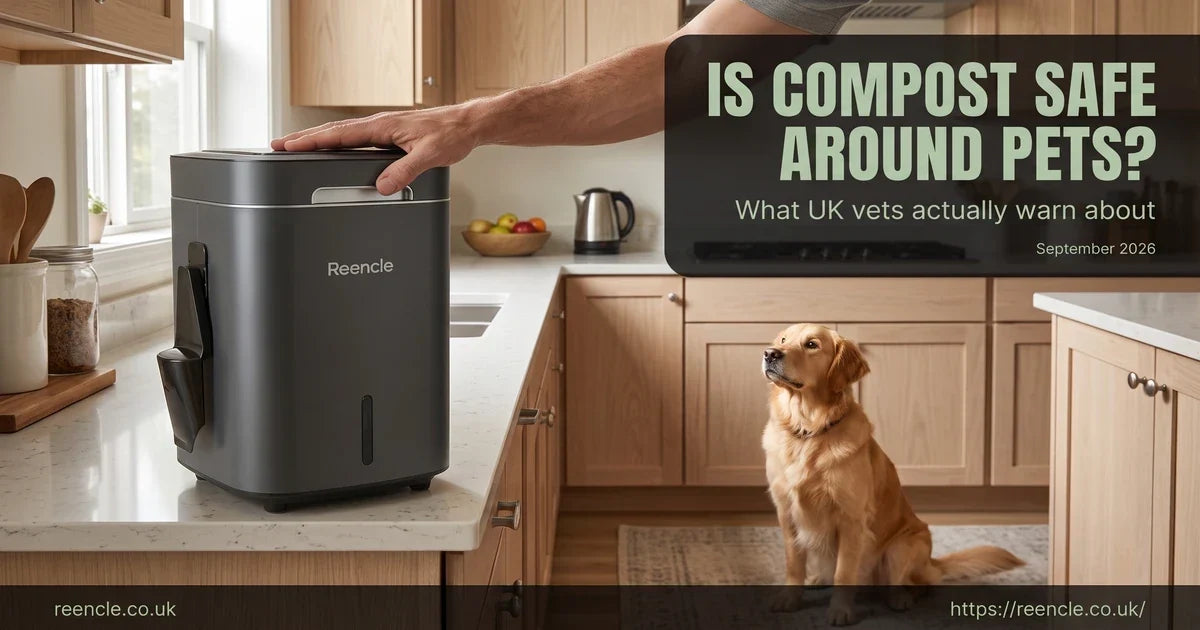
Dark grey Reencle composter on a kitchen worktop with a calm dog sitting at a safe distance nearby.
Pet Safety / Composting Basics

Is Reencle Compost Safe Around Pets? What UK Vets Actually Warn About

UK vets warn about mould and mycotoxin poisoning from compost, but every source describes the risk in terms of active, mouldy heaps. No vet or toxicology source confirms that Reencle's cured, finished output carries a lower risk. Here's exactly what's known, what isn't, and what to do if a pet gets into compost of any kind.

Dark grey Reencle composter with its lid closed and latched on a kitchen worktop, ready for secure daily use.
Keeping the lid closed and latched is the simplest way to keep curious pets out of the compost.

By Bev Barraca · 3 September 2026

A dog nosing round the compost bin, or worse, already swallowing a mouthful before anyone's noticed, is the moment this post is for. UK vet organisations are clear that compost can make dogs seriously ill, and they're specific about how. What they don't do is separate an active, decomposing heap from compost that's finished breaking down and cured, the way Reencle's output has. This post sets out what vets actually warn about, what "finished compost" means for a Reencle, what genuinely isn't known yet, and what to do if a pet eats compost, whatever kind it is.

Method 01

What tremorgenic mycotoxin poisoning actually is

Tremorgenic mycotoxins are compounds produced by mould growing on foodstuffs. The two most commonly involved are penitrem A and roquefortine (VPIS, "Mouldy Food and Tremorgenic Mycotoxins"). They're the same family of toxins behind dogs becoming seriously unwell after eating mouldy bread or blue cheese. There's nothing about "compost" as a category that causes the reaction. It's a reaction to mould toxins, full stop, and mould grows wherever the right food and moisture turn up, compost heap or otherwise.

Mouldy bread heel and a cheese rind with visible mould spots on a wooden chopping board.
VPIS names mouldy bread and mouldy dairy as everyday sources of the same toxins found on compost heaps.
Key takeaway: it's a mould-toxin reaction, not a reaction to compost specifically. Mould is the hazard. Compost is just one of the places it commonly grows.
Method 02

Where vets say the risk comes from

The UK's Veterinary Poisons Information Service (VPIS) names the specific sources it sees causing tremorgenic mycotoxin poisoning in dogs: mouldy bread, mouldy dairy such as yoghurt and cream cheese, very mouldy blue cheese, mouldy fallen fruit and nuts, and "plant material and food waste rotting on a compost heap" (VPIS, "Mouldy Food and Tremorgenic Mycotoxins"). Vets Now, whose veterinary nursing team writes on garden hazards for dog owners, puts it just as directly: "Compost is usually full of mouldy food and garden waste. Some of this can produce mycotoxins, which are highly dangerous to dogs" (Vets Now, "15 Hazards to Avoid for a Dog-Friendly Garden," Racheal Marshall, Head of Clinical Nursing). Read across every source and the common thread is active mould growth on decomposing material. Not any one particular type of waste.

Key takeaway: the danger comes from active mould growing on rotting material, whatever that material is or wherever it's sitting.
Method 03

What "finished compost" means for a Reencle

A Reencle breaks food waste down in roughly 24 hours, then the output needs a further 3 weeks of curing before it counts as finished compost, around 30 days start to finish (reencle.co.uk, How It Works). That's a genuinely different process to a garden heap, which can sit wet, decomposing and mouldy for months, especially through a damp UK winter. So it's a fair question: does that curing period change the mould or mycotoxin picture?

It's also a question nobody has actually answered. No vet or toxicology source found distinguishes finished, cured compost from an active heap on this point, anywhere. Curing changes how the material looks and behaves. It has not been shown, by any source checked for this post, to change whether it's safe for a dog to eat.

For more on what curing achieves once compost is ready to use in the garden, see How Compost Benefits Plants.

Key takeaway: curing explains what happens to the waste during those 30 days. It doesn't, on any evidence found, tell you the output is safe for a pet to get into.
Warning: don't read "finished compost" as "safe to leave within reach of a dog." No source supports that reading.
Method 04

What isn't known: the honest gap

Worth stating plainly rather than skating past it. No UK vet, toxicology or public health source has tested or commented on mould-spore or mycotoxin levels in finished, cured compost specifically, whether from a Reencle or any other composter. Reencle's own output hasn't been independently tested for this either. Every warning available, from VPIS and from Vets Now, treats "a compost heap" as a single, undifferentiated hazard. No active-versus-cured distinction is drawn anywhere in the material checked.

So the honest answer to "does curing make it safer" is: not confirmed, either way. Not "probably yes." Not "probably no." Genuinely unknown until someone tests it.

Key takeaway: treat all compost, finished or otherwise, with the same precautions, because no research currently distinguishes between them.
Method 05

Symptoms to watch for and how fast they can appear

Signs of tremorgenic mycotoxin poisoning can start fast. VPIS is specific: "An animal can become unwell within 30 minutes but sometimes signs may take up to 3 hours to start" (VPIS, "Mouldy Food and Tremorgenic Mycotoxins"). Watch for tremors, often affecting the whole body, vomiting, a raised body temperature, twitching, panting and a raised heart rate. In severe cases this can progress to convulsions, coma and kidney injury (VPIS, "Mouldy Food and Tremorgenic Mycotoxins").

Flat infographic listing dog mycotoxin symptoms and a 30 minute to 3 hour onset window, sourced to VPIS.
Symptoms can start within 30 minutes and sometimes take up to 3 hours to appear, according to VPIS.
Key takeaway: symptoms can appear within 30 minutes and sometimes take up to 3 hours, so don't assume a clear first hour means a pet is in the clear.
Warning: symptoms can appear fast. Don't wait to see whether they pass on their own.
Method 06

What to do if a pet eats compost

Move the pet away from the compost straight away. Don't try to make them vomit, and never give salt water to try to induce it (VPIS, "Mouldy Food and Tremorgenic Mycotoxins"). Then get advice straight away. There are two legitimate first calls here, not one: your own vet practice, or Animal PoisonLine on 01202 509000, a 24-hour advice line for owners run by VPIS, which charges for calls (VPIS, "Mouldy Food and Tremorgenic Mycotoxins"). VPIS's own guidance tells owners to "call Animal PoisonLine on 01202 509000 even if your pet is showing no signs to find out whether a trip to the vet is required." When you call, be ready to say what was eaten, roughly how much, and when, and take a sample with you if you're advised to bring the pet in.

Four-step flat infographic: move the pet away, do not induce vomiting, call your vet, describe what was eaten.
Four steps VPIS recommends if a pet has eaten compost, starting with moving them away from it.
Key takeaway: get the pet away from the compost, don't try to make them sick, and call your vet or Animal PoisonLine on 01202 509000 straight away, even before symptoms show.
Warning: never give salt water or attempt to induce vomiting at home.
Method 07

Keeping compost secure day to day

The practical fix is the same regardless of what produced the compost. Keep a lid on the compost bin or caddy and keep it secured. Don't leave finished compost sitting out in a loose pile on beds where a dog can dig into it. Work it into the soil rather than leaving it exposed, and store bagged Compost Starter and any unused finished compost somewhere pets can't reach.

Dog standing calmly in a garden several feet from a closed, lidded compost bin on a patio.
A closed lid and some distance are what actually keep a dog safe around any compost, Reencle or otherwise.

If you don't have anywhere to dig compost into, secure storage matters even more. See our guide on what to do with Reencle output if you have no garden for options that still keep finished compost away from pets.

Key takeaway: how securely compost is stored matters more to pet safety than which composter produced it.

Quick Reference

Reencle compost and pet safety at a glance

Question What's confirmed Source
What causes the poisoning Tremorgenic mycotoxins (penitrem A, roquefortine) produced by mould on decomposing material VPIS
Symptom onset window Within 30 minutes, sometimes up to 3 hours VPIS
First symptoms Tremors, vomiting, raised body temperature, twitching, panting, raised heart rate VPIS
What to do first Move the pet away, don't induce vomiting, call your vet or Animal PoisonLine VPIS
Does curing change the risk Not confirmed either way by any source found VPIS; Vets Now
Who to call Your own vet, or Animal PoisonLine on 01202 509000 (24-hour, charges apply) VPIS
Expert Insight

What a UK vet nursing lead says about compost and dogs

Racheal Marshall, Head of Clinical Nursing at Vets Now, is named as the source on the organisation's guidance for dog owners on garden hazards. Writing on compost specifically, the Vets Now team states: "Compost is usually full of mouldy food and garden waste. Some of this can produce mycotoxins, which are highly dangerous to dogs. Mycotoxicosis, which is poisoning by products contaminated by fungi, can be fatal. Always keep compost out of reach and seek urgent veterinary advice if you suspect your dog has raided the compost bin." (Vets Now, "15 Hazards to Avoid for a Dog-Friendly Garden," Racheal Marshall, Head of Clinical Nursing)

For the underlying mechanism, the Veterinary Poisons Information Service, which has provided advice to vets on managing animal poisoning cases for over 30 years, identifies the specific compounds involved and confirms they're produced by mould growing on foodstuffs, including material on a compost heap (VPIS, "Mouldy Food and Tremorgenic Mycotoxins").

Neither source distinguishes an active heap from cured, finished compost. That gap applies equally to Reencle's output and to any other compost.

Comparison infographic showing an active compost heap and cured compost both marked with the same warning level.
No UK vet or toxicology source distinguishes an active heap from cured, finished compost on pet risk.

FAQ

Common Questions

Can dogs get sick from eating compost?

Yes. UK vets warn that compost can contain tremorgenic mycotoxins, toxic compounds produced by mould on decomposing material, which can cause tremors, vomiting and a raised body temperature in dogs, and can be fatal in severe cases (VPIS, "Mouldy Food and Tremorgenic Mycotoxins").

Does finished compost pose the same risk as an active compost heap?

No source found says either way for certain, so treat them the same. No UK vet or toxicology source distinguishes cured, finished compost from an active, decomposing heap on mould or mycotoxin risk, so the same precautions apply regardless of how finished the compost looks.

How quickly do symptoms of mycotoxin poisoning appear in dogs?

Symptoms can start within 30 minutes, and sometimes take up to 3 hours to appear (VPIS, "Mouldy Food and Tremorgenic Mycotoxins"). Don't assume a clear first hour or two means a pet hasn't been affected. Watch closely regardless.

What should I do if my dog eats compost?

Move them away from the compost immediately and don't try to make them sick. Call your own vet practice, or Animal PoisonLine on 01202 509000, a 24-hour owner advice line, straight away, even if they're not showing symptoms yet (VPIS, "Mouldy Food and Tremorgenic Mycotoxins").

Is Reencle compost more dangerous to pets because it processes meat and dairy?

No UK vet or toxicology source specifically compares mould risk in protein-inclusive processed compost against plant-only garden compost, so the same universal precautions apply regardless of what went into the composter. This hasn't been studied publicly either way.

🐾

The bottom line

Reencle turns everyday scraps into compost in around 30 days, but finished compost still needs to be kept well away from curious pets, just like any other compost.

And the scraps? Mouldy bread ends, leftover cheese rinds nobody's going to eat, and windfall apples or plums from the garden are exactly the kind of scraps that, left loose in an open caddy or on the ground, are what UK vets warn dogs get into. Left out like that, they're also headed for landfill, where they add to UK household food waste rather than being put to any use. Putting them into a Reencle instead means they're processed inside a closed unit rather than sitting in an open bin or spread across the garden waiting to be found. It also means less time spent worrying about what's accessible in the kitchen bin between collections.

See how the Reencle composter works →
Reading next

Dark grey Reencle composter on a pale kitchen counter, with the filter replacement question as the overlay headline.
Hands placing a dark grey Reencle composter into an open cardboard moving box on a kitchen counter.

Leave a comment

This site is protected by hCaptcha and the hCaptcha Privacy Policy and Terms of Service apply.