
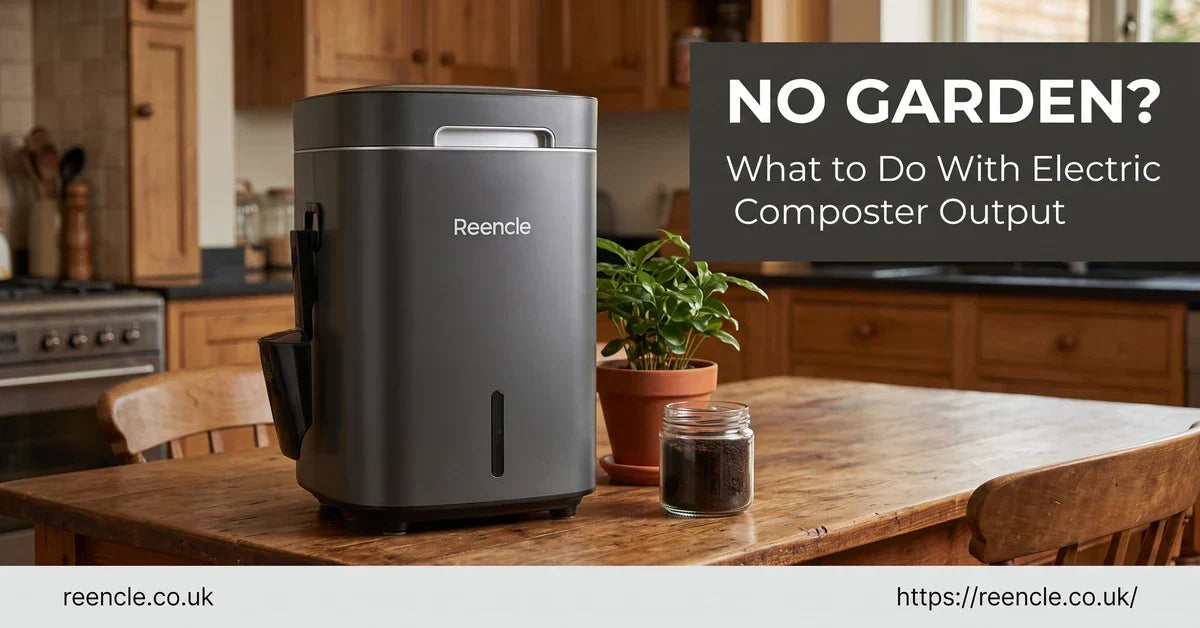
What to Do With Reencle Output If You Have No Garden
You have your Reencle composter on your worktop and a growing collection of pre-compost in a sealed tub. No garden, no allotment, no lawn. Here are three practical routes, in order of effort, to make sure none of it goes to waste.
 If you're composting food waste in a flat with no outdoor space, the question of what to do with the output isn't abstract. It's the practical blocker that stops a lot of people starting in the first place. Banana peel, coffee grounds, strawberry tops, cooked rice: all of it gets processed by the Reencle's microbial culture into a dark, earthy pre-compost. Then what?
There are three workable routes, each requiring different amounts of effort. The first is your council food waste bin, which may accept processed microbial output depending on your borough. The second is Peels, a free community composting map that replaced ShareWaste at the end of 2024 and connects you to local composters willing to receive scraps. The third is your houseplants, but only after proper curing, and only in the right ratios.
This guide covers all three, with specific numbers, realistic expectations, and no claims that can't be sourced.
Contents
The council food waste bin: a legitimate first option, with one important caveat
 The new Simpler Recycling rules for food waste collection came into effect on 31 March 2026, and represent a major change for many households in England. Under these rules, councils in England should now provide households with weekly collections of organic leftovers, such as vegetable peelings and plate scrapings.
If your borough has rolled out a caddy, you already have a legal collection route for food waste. The question for Reencle users specifically is whether processed microbial output (dark, earthy, partially broken-down material rather than raw scraps) counts as food waste under the scheme.
The honest answer: it depends on the borough, and you should check before putting processed output in the caddy.
The definition of food waste under Simpler Recycling is set out in The Separation of Waste (England) Regulations 2024. Broadly, food waste includes all food intended for human or pet consumption, plus biodegradable material from food and drink preparation, including fruit and vegetable peelings, bones, eggshells, coffee grounds, tea bags, bread, cooked food, and any food past its use-by date. Microbially processed compost is biodegradable material derived from food preparation, so the argument for inclusion is reasonable. But each processor that handles collected food waste operates under its own specifications, and some will flag heavily broken-down organic material as different from what they expect.
A quick email to your council's waste team, or a search of their food waste FAQ page, takes two minutes and removes the uncertainty. Most councils publish specific lists of what they accept. Some actively encourage home composting for vegetable peelings and use the food caddy for items that can't be composted at home: meat, fish, dairy, cooked meals. Durham County Council, for example, encourages residents to continue composting at home and use the food waste caddy for types of food that are difficult to compost at home, such as meat, fish, bones, cooked food, and dairy products.
The practical implication for Reencle users: if your borough accepts processed organic material in the caddy, it's a simple, low-friction route for any surplus output you can't use or give away. If it doesn't, the routes below are your options.
One caveat worth noting: not everyone will actually gain food waste collection from the end of March. A BBC investigation found that a quarter of councils are set to miss the deadline, blaming a lack of specialist collection vehicles and funding gaps. If your borough hasn't yet rolled out food waste collection, this route isn't available to you yet. Use Peels or the houseplant route below.
Why Reencle output is not the same as dehydrator output, and why it matters for every route in this post
Before covering community drop-off and houseplant use, it's worth being precise about what Reencle output actually is. The handling advice differs significantly between a microbial composter and the dehydration-based machines that dominate most "electric composter" search results. Our full comparison of Reencle, Lomi, and Sage FoodCycler covers this in depth, but the key distinction is worth stating clearly here.
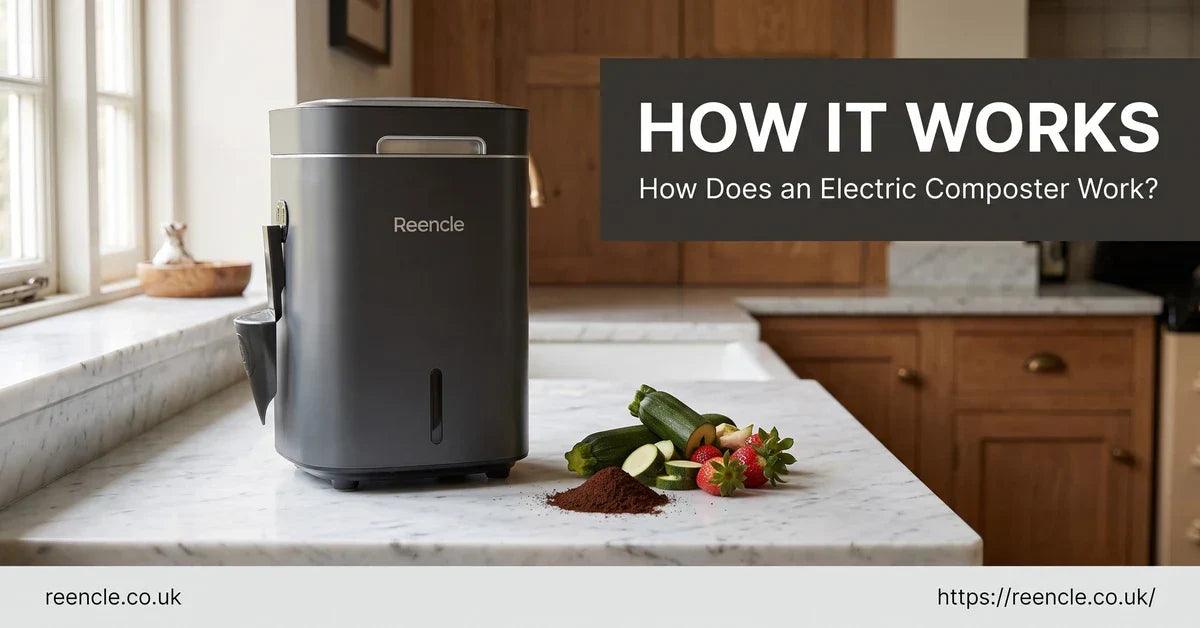
The term "electric composter" gets applied loosely to two distinct machine categories: dehydration-based machines, which use heat and mechanical grinding to dry and reduce the volume of food waste (examples include Lomi and the Vitamix FoodCycler), and microbial composters, which use live microbial cultures and controlled aerobic conditions to biologically decompose food waste.
The outputs aren't equivalent. One produces dried, sterilised food waste. The other produces material that has undergone real biological transformation: the beginning of actual compost.
Unlike electric food dehydrators that simply dry food waste, the Reencle uses biological decomposition accelerated by a controlled environment. Inside the unit, a resident microbial community of bacteria and fungi specifically selected for rapid, effective organic matter breakdown lives in the base medium.
What you remove from the Reencle is technically pre-compost or immature compost. The microorganisms have already done the primary work of breaking down organic matter, but the material benefits from a short additional curing period before being applied to plants.
This matters in practice because dehydrator output applied directly to plant roots can cause problems. Dehydrator output is dried food material. The organic compounds are intact and haven't been broken down by microorganisms. Applied directly to soil, it continues to decompose there, drawing nitrogen from the soil in the process, which can temporarily stress plants.
Reencle output has already been biologically processed. The microbial community has consumed and metabolised the organic material. Applied to soil after a curing period, it adds stable organic matter and beneficial microorganisms rather than competing with plants for soil nitrogen.
The practical upshot: Reencle output is ready to benefit a community garden's compost bay or your monstera's potting mix, after the curing step described in Method 05. Dehydrator output from machines like Lomi or the FoodCycler needs more time buried in soil before it reaches an equivalent state.
Peels: the current ShareWaste replacement for UK flat-dwellers
If your borough's caddy isn't an option, or you want the output to go directly to a local composter rather than an industrial anaerobic digestion plant, Peels is the most direct community route available.
ShareWaste shut down at the end of 2024. Peels is filling the gap it left, and you can think of it as a direct replacement. It's a community composting map that helps people find nearby places to drop off food scraps, or create a listing if they can accept scraps from neighbours. It connects people with food scraps to those who compost, and is a free, non-commercial, community project.
How it works in practice: open the Peels map and look for a nearby host or community garden that accepts food scraps. Select a listing to see what they accept, where they are, and how to contact them. You then arrange a drop-off directly with the host.
One honest note on coverage: most hosts are currently in Australia and the USA, but the platform is also seeing compost communities spring up in New Zealand and the UK. UK coverage is growing but is thinner than in cities like Melbourne or Sydney where community composting networks are more established. If you search your postcode and find no nearby hosts, two options follow: you can add your own listing (which benefits others in your block or street who might want to share a pick-up route), or move to the community garden approach below.
Peels is listed by councils and supported by people, making community composting easier to find, so if you have contact with your local councillor or residents' association, flagging Peels to them is worth doing. More hosts in your area directly increases your own options.
Community gardens, allotments, and neighbours: the analogue route
If Peels has no nearby hosts, the direct approach works just as well. If you can't find a suitable drop-off on an app, you may have more luck dropping it off at a community garden, allotment, or local market.
Community gardens in particular are often actively looking for input material. In Hackney and Camden, for example, a number of estates offer community composting schemes that work well. These are largely resident-led but receive support from the borough's waste team. Compost produced is mostly used on the estates' gardens and balconies.
The practical approach: search "[your area] community garden" on Google Maps, then email or call to ask whether they accept pre-composted organic material. Framing it as "partially broken-down food waste from a home microbial composter" tends to land better than "electric composter output," which can prompt uncertainty. Most community garden composting operations are built around adding diverse organic inputs to their own bays, and Reencle output, dark, earthy, biologically active, is exactly what they want.
Allotment holders are another reliable route. Allotment waiting lists run 5 to 10 years across UK councils, which means plot holders are genuinely invested in soil health and often welcome additional compost inputs. If you know anyone on a plot, offer them the output directly. Most allotment holders would rather receive a tub of pre-compost than buy a bag of commercial compost.
Neighbours with gardens or houseplant collections are also worth asking. A small tub of cured Reencle output, labelled clearly, is a straightforward gift, particularly for people who grow tomatoes, peppers, or herbs in pots. Word gets around a stairwell quickly.
Using Reencle output on houseplants: curing times, ratios, and which plants respond best
If you have even a windowsill or balcony with houseplants, Reencle output can go directly to use at home. This is the most satisfying route, but it requires two things done correctly: the right curing time, and the right application ratio. For more on aligning compost output with your growing schedule, see our guide on seasonal gardening with Reencle.
Why curing matters
If you're using output from a home composter like the Reencle, cure the material for a full 30 days before use with any potted plants. Spread it thinly in an open container or garden area, keep it slightly moist, and let the microbial community mature.
Curing matters more for pots than for garden beds because in a garden bed, soil volume dilutes the effects of partially cured compost. In a 6-inch pot, there's nowhere for volatile compounds to go. Fresh compost can release ammonia, contain incompletely broken-down organic acids, and carry a higher load of non-beneficial microorganisms competing for the same root space.
After 30 days, the material should smell earthy (not sharp or acidic), be dark and crumbly, and have stabilised into something genuinely beneficial. If it still smells slightly acidic or sweet, give it another week before use.
Reencle output vs dehydrator output: different curing requirements
Microbial composter output from systems like the Reencle is biologically active compost: the biology is the same as an outdoor pile, just managed in a different environment. For use in containers, a curing period of 2 to 4 weeks in a bin or bag after collection from the unit is recommended to allow full maturation.
Dehydrator output is a dried, ground material that must complete decomposition in soil. It shouldn't be called "compost" in the technical sense. When used, it should be mixed into soil at a ratio of no more than 10 to 15% by volume and allowed several weeks to break down further.
Reencle output, after curing, can be applied at higher ratios and more immediately benefits plants because the biological transformation has already occurred.
Application ratios
For most houseplants, the target ratio is 10 to 20% compost by volume in the potting mix. For a standard 6-inch pot: roughly 1 to 2 tablespoons of compost per cup of potting mix. For a 10-inch pot: roughly half a cup of compost per 2 cups of potting mix.
The Reencle's own guidance aligns closely: mix 1 part compost with 4 parts soil, cure the mixture for 3 weeks in a breathable container, and it's ready when it's dark, crumbly, and smells earthy.
Which houseplants respond best
Ferns, Boston, Maidenhair, and Bird's Nest varieties, evolved in forest floors deep in decomposing leaf litter, are biologically adapted to rich, humus-heavy growing media. A 15 to 20% compost ratio in the potting mix produces noticeably fuller, greener fronds.
For most leafy tropical houseplants, pothos, monsteras, ferns, philodendrons, the biological boost from compost translates to more vigorous growth, richer leaf colour, and better resilience against stress. For further ideas on integrating Reencle compost into urban gardening, including balcony planters and rooftop containers, our dedicated guide covers the full range of options.
Succulents and cacti are not well suited to rich compost mixes. Keep the ratio to 5% or lower, or skip compost entirely for desert-adapted plants.
A note on compost tea
If you have more output than your pots can absorb, compost tea is an efficient way to extend your supply. Add 2 to 3 tablespoons of mature, cured compost in a small mesh bag or old nylon stocking, stir or shake vigorously, or add a small aquarium airstone for 24 hours. The resulting liquid can be used as a soil drench around the root zone, diluted to a light amber colour.
Quick Reference
Which output route is right for your situation?
| Situation | Recommended Route |
|---|---|
| Borough has active food waste caddy collection | Check council FAQ, then add processed output to caddy if confirmed accepted |
| Borough has missed the March 2026 deadline | Use Peels drop-off or community garden route while waiting |
| Peels has a host within walking distance | Drop off directly via peels.app: free and immediate |
| No Peels hosts nearby, but community garden local | Email garden directly; offer as "microbial pre-compost" |
| Neighbour has garden, allotment, or grows herbs | Gift directly: a tub of cured output is a useful present |
| Have houseplants (pothos, monstera, ferns) | Cure for 30 days, apply at 10 to 20% ratio in potting mix |
| Only have succulents or cacti | Compost tea at low dilution, or Peels/caddy route preferred |
| Producing more output than you can use | Combine routes: houseplants take some, caddy or Peels takes the rest |
| Balcony with planters or grow bags | Direct use in containers after 30-day cure; coffee grounds, banana peel, and herb stems process well |
What actually happens to food waste after council collection, and why home composting still adds value
The shift to mandatory food waste collection under Simpler Recycling is a genuine improvement in how the UK handles organic waste. The food collected by councils goes to anaerobic digestion or in-vessel composting and becomes biogas or soil improver. Anaerobic digestion converts the collected food into renewable energy. The biofertiliser produced can be used in farming, and the biomethane gas produced can be used to power homes and local communities.
That's a meaningfully better outcome than landfill. But it's worth understanding what anaerobic digestion does and doesn't produce. The process generates biogas and a digestate used as agricultural fertiliser. It doesn't produce the kind of biologically rich, humus-building compost that goes back into soil in a form that directly benefits garden plants or houseplants. The end product is useful at scale, but it's a different thing from the output of a microbial composter cured at home.
According to WRAP UK Food Waste Key Facts, households account for 70% (or 6.7 million tonnes) of UK food waste. The average household spends £470 on food every year that ends up in the bin. Council collection routes are essential for the portion of that waste that can't be managed at home: large volumes, cooked food, meat, fish. But for a flat-dweller running a Reencle, the output is already partially processed and biologically active. Sending that material to an allotment, a community garden, or a monstera on the windowsill closes a shorter loop with less energy expenditure than industrial processing.
Among those who already recycle food waste, 29% agreed that they think more about reducing their food waste as a result, according to a Which? survey conducted in December 2025. The same pattern applies to home composting: managing output consciously tends to make waste generation more visible. Fewer overripe bananas left in the bowl. More strawberry tops going in the Reencle rather than the bin.
FAQ
Common Questions
Can I put Reencle output directly into my council food waste caddy?
Possibly, but check with your borough first. Reencle output is biodegradable organic material derived from food preparation, which broadly fits the definition of food waste under the Separation of Waste (England) Regulations 2024. Each council's processing contract specifies what it expects, though, and some may distinguish between raw food scraps and pre-processed material. A two-minute email to your waste team removes the uncertainty. Most London boroughs that already run established food caddy schemes are the most likely to accept it without issue.
ShareWaste used to be my go-to for drop-off composting. Is Peels genuinely a replacement?
Yes. ShareWaste shut down at the end of 2024, and Peels was created specifically to fill that gap. It works the same way: a free community map at peels.app where you find nearby hosts, arrange a drop-off via the platform's messaging function, and deliver your scraps or output to someone who composts. UK listings are less dense than in Australia at the moment, but the platform is growing. If there's no host near you yet, adding your own listing, even if you only have a balcony planter, helps others on your street find somewhere to go.
How do I know when my Reencle output has cured long enough to use on houseplants?
Two reliable tests. First, smell: cured output smells earthy and clean, similar to forest soil. If it still has a sharp, acidic, or sweet odour, it needs more time. Second, texture: it should be dark and crumbly, not sticky or wet. The standard curing target is 30 days in an open or breathable container kept slightly moist. At that point it's safe to mix into potting compost at a ratio of 10 to 20% by volume, and safe to apply as a topdress to established pots.
Is it worth composting at home if my council already collects food waste weekly?
For most flat-dwellers, yes. Council collection handles what you can't compost at home: fish bones, meat, large volumes of cooked food. A Reencle handles everything else continuously, reduces the smell and volume in your caddy between collections, and produces a usable output you can give to plants or local composters. The two routes complement each other. The council caddy is a safety valve for the portion of food waste the machine hasn't yet processed; the Reencle is the primary processing route for the daily stream of avocado stones, coffee grounds, pasta water residue, and courgette offcuts.
My flat produces very little output from the Reencle. Is the Peels drop-off worth the trip?
Store output in a sealed container in the fridge or a cool cupboard and accumulate a few weeks' worth before making the trip. A single drop-off of 300 to 500 grams of cured pre-compost is genuinely useful to an allotment holder or community garden. Batch it rather than making multiple small trips. If the nearest Peels host is further than you want to walk, the houseplant route is more practical for small volumes: a 6-inch pot requires only 1 to 2 tablespoons of compost mixed into the potting soil.
The bottom line
The Reencle's dark grey unit sits on your worktop, processes everything from mango skins to leftover pasta, and produces an output that has real value: to your houseplants, your neighbours, and your community garden.
Without a garden, those scraps (banana skins, coffee grounds, herb stalks, overripe strawberry tops, avocado skins, and courgette offcuts) would default to the bin, then landfill, where they generate methane. The Reencle intercepts that stream continuously, using a live microbial culture to do the biological heavy lifting. This is not a dehydrator producing dried food powder: it's genuine aerobic decomposition, the same process as an outdoor compost heap, miniaturised to a worktop unit. The output is biologically active pre-compost. Cure it for 30 days in a tub on your balcony, under the sink, or in a cool cupboard, and it becomes something your monstera, your neighbour's raised bed, or a local community garden can genuinely use. The Reencle runs at around 30p a day, needs emptying every one to three months, and the microbes are self-perpetuating. They don't need replacing between batches. For a no-garden household, the output question answers itself once you have a plan: houseplants and Peels handle most of it, and the council caddy takes any surplus. None of it needs to go to landfill. See our full guide on how Reencle saves money long-term if you're weighing up whether the upfront investment makes sense.
See the Reencle on reencle.co.uk →

Leave a comment
This site is protected by hCaptcha and the hCaptcha Privacy Policy and Terms of Service apply.