
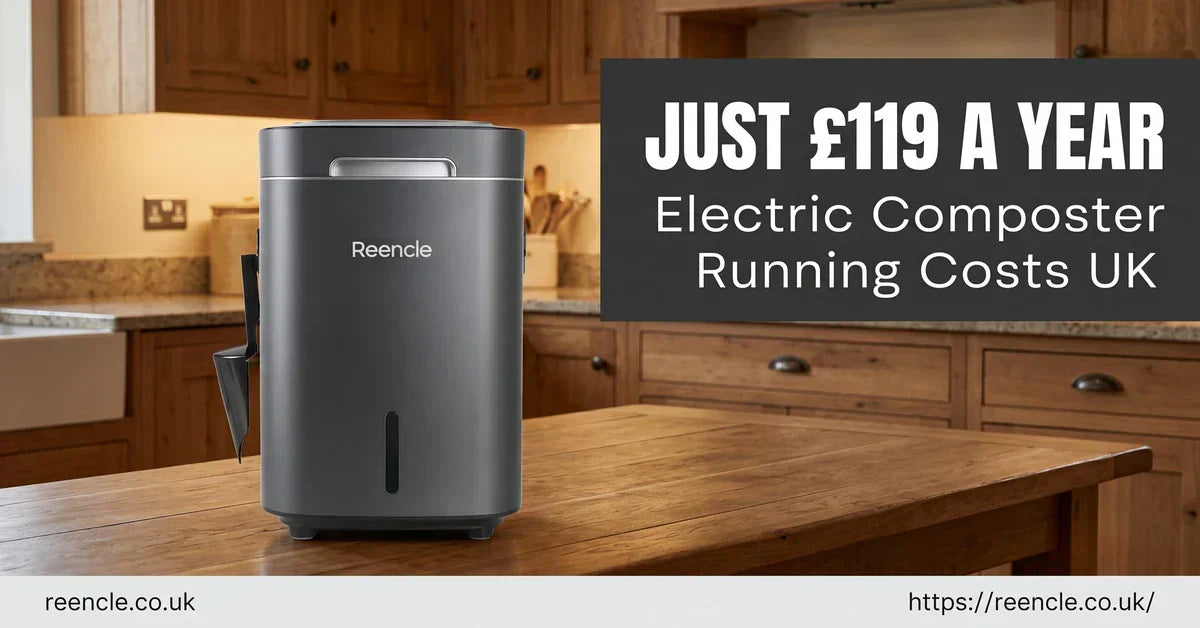
Electric Composter Running Costs in the UK: The Exact Annual Cost Calculation
Using the confirmed Ofgem Q3 2026 rate of 26.11p/kWh, we work through every penny of a Reencle's annual running cost. It costs less than you probably expect, and far less than most appliances you already own.
 Electric composter running costs are genuinely misunderstood in the UK. That misunderstanding stops a lot of households from making a purchase that would, in the long run, save them both money and waste. Here are the facts: the Reencle home composter uses 1.25 kWh per day. At the Ofgem Q3 2026 electricity rate of 26.11p/kWh, the annual electricity cost works out to exactly £119.13. Not an estimate hedged with caveats. A straightforward multiplication we'll walk through in full, step by step, so you can check it against your own tariff.
What does £119 per year actually mean? Roughly 33p a day. It sits below the annual running cost of a tumble dryer, a dishwasher, or an electric shower used daily. For a device that runs continuously, processes your food scraps, and produces finished compost you'd otherwise pay for at the garden centre, that number tells a rather different story to the one most buyers fear. For more on the wider financial case, see our guide to how a Reencle can save you money.
Everything here uses real UK data: Ofgem-capped unit rates, Which? appliance benchmarks, and Reencle's verified technical specification of 1.25 kWh per day.
Contents
The Official Ofgem Q3 2026 Electricity Rate and Why It Matters
 Ofgem sets a price cap on the unit rate of electricity for households on standard variable tariffs across England, Scotland, and Wales. For Q3 2026 (1 July to 30 September 2026), the confirmed average electricity unit rate is 26.11p/kWh including VAT at 5%. That's up 13% from the Q2 2026 rate of 24.67p/kWh. The cap doesn't fix what you pay. It fixes the maximum rate per unit a supplier can charge on a default tariff. Your actual rate may differ slightly by region and payment method.
For any appliance running cost calculation, 26.11p/kWh is the correct benchmark for the second half of 2026 if you're on a standard variable tariff. Fixed-rate tariff holders may pay more or less depending on when they locked in. Ofgem publishes each quarter's cap ahead of the change date, so updating any calculation as rates shift is straightforward.
The rate matters most for low-wattage devices that run continuously. A tumble dryer drawing 2,500W for one hour consumes 2.5 kWh and costs 65p per cycle. A Reencle drawing an average of around 52W continuously consumes that same amount of energy over two full days. Very different maths, and that's the crux of why the running cost is more manageable than most buyers initially assume.
Step-by-Step: The Exact Annual Running Cost Calculation for a Reencle
The calculation is entirely transparent and contains four values: daily energy consumption in kWh, days in a year, the unit price in pence per kWh, and a conversion from pence to pounds. Here's the full working:
- Daily consumption: 1.25 kWh
- Days per year: 365
- Unit rate (Ofgem Q3 2026): 26.11p/kWh
- 1 Annual consumption = 1.25 x 365 = 456.25 kWh
- 2 Annual cost in pence = 456.25 x 26.11 = 11,913.09p
- 3 Convert to pounds = 11,913.09 / 100 = £119.13
 The Reencle costs £119.13 per year to run at the Q3 2026 Ofgem unit rate. That's 32.6p per day, or approximately £9.93 per month. These aren't rounded approximations. They follow directly from Reencle's published specification of 1.25 kWh per 24 hours, documented as 0.052 kW per hour sustained over a full day.
One thing worth being precise about: "1.25 kWh/day" doesn't mean the device runs flat-out for 24 hours. The Reencle cycles between active mixing and aeration periods and lower-power idle modes. The 1.25 kWh figure is the total energy drawn across a full day regardless of cycle pattern, which makes it the correct input for a cost calculation rather than a peak-wattage estimate.
How 1.25 kWh/Day Compares to Other Always-On Appliances
The most honest comparison for the Reencle is with other appliances that run 24 hours a day, because those are the ones shaping your baseline electricity bill. A modern A-rated fridge-freezer consumes approximately 1.1 kWh per day, around 408 kWh per year, costing roughly £65 to £80 annually at current rates. The Reencle, at 1.25 kWh/day or 456 kWh/year, draws very slightly more than a fridge-freezer. That's a useful reference point, because almost every UK household accepts the fridge as a non-negotiable running cost.
A broadband router typically draws 7 to 12W continuously, adding around 70 to 105 kWh per year, or about £18 to £27. A smart TV on standby adds a further 10 to 30 kWh per year. These always-on devices collectively consume more energy than most people realise. The Reencle sits in the same conceptual bracket: a low-wattage device running continuously rather than a high-wattage device used occasionally.
 Older or less energy-efficient fridge-freezers (B or C rated) can consume 400 to 600 kWh per year, costing £130 to £180 at Q3 2026 rates. On that basis, a Reencle actually costs less to run annually than an older fridge-freezer. For households already running an older refrigeration unit, that comparison reframes the Reencle from a luxury add-on to a very ordinary running cost.
How a Reencle Compares to Higher-Usage Kitchen Appliances
Not all appliances run continuously, and comparing the Reencle to occasionally used appliances shows how modest the annual cost really is. A tumble dryer running 150 cycles per year costs between £155 and £210 annually for a conventional condenser model, or £60 to £95 for a heat pump model. Even the cheapest tumble dryer option exceeds the Reencle's running cost, and most households run a condenser dryer far more than 150 times a year through a wet UK winter.
 A dishwasher run 250 times a year costs £55 to £100 per year depending on its energy rating, according to Which? testing data. The midpoint of that range is comparable to the Reencle's annual cost, and a dishwasher isn't running continuously the way the Reencle does. A washing machine running four loads per week for a full year costs around £64 at Q3 2026 rates, again less than the Reencle's £119, but a washing machine is doing two wash cycles most days of the week rather than ticking over at low power.
An electric shower running at 9kW for eight minutes per day draws around 1.2 kWh per use. One daily shower from an electric unit costs approximately 31p at Q3 2026 rates, or roughly £115 per year for one person. Almost identical to the Reencle's annual cost. Most households run multiple showers daily. The point isn't to suggest these appliances are unaffordable. It's to show that the Reencle sits within a completely familiar and accepted range of household running costs.
The Real-World Cost Across Different UK Electricity Tariffs
The £119.13 figure above uses the Q3 2026 Ofgem cap rate of 26.11p/kWh. Your actual rate depends on your tariff type. Households on Economy 7 or time-of-use tariffs may pay a lower overnight rate. Since the Reencle runs continuously, you can't easily shift all its consumption to off-peak hours the way you might with a storage heater or an overnight EV charge. If roughly half its consumption falls within off-peak windows, though, total costs could reduce.
At different unit rates, the annual cost for 456.25 kWh of consumption changes as follows:
- At 20p/kWh £91.25/year
- At 24.67p/kWh (Q2 2026) £112.55/year
- At 26.11p/kWh (Q3 2026) £119.13/year
- At 30p/kWh £136.88/year
- At 35p/kWh £159.69/year
For households on a fixed-rate tariff locked in below 26p/kWh, the cost will be lower than the headline £119 figure. For those on higher rates, particularly where energy prices spike in a future quarter, the cost will be higher. The Q3 2026 figure represents a reasonable current benchmark for budget planning.
 One thing to note: the Ofgem cap covers a standard variable tariff for a typical household. The standing charge (57.19p/day in Q3 2026) is separate and is the same regardless of whether you own a Reencle or not, so it doesn't factor into the marginal running cost of the appliance.
What Drives the Running Cost: How the Reencle Uses Electricity
Understanding what the Reencle actually does with that 1.25 kWh per day makes the running cost figure feel more intuitive. The device maintains a warm, aerated chamber that sustains a colony of microorganisms called ReencleCare, which are the active composting agents. To do this, it runs a small heating element to hold the internal temperature within the optimal range for microbial activity, a low-speed stirring mechanism that periodically agitates the contents, and a fan system for airflow and odour control.
None of these components is high-wattage. The average draw across 24 hours works out to approximately 52W, slightly less than a traditional 60W incandescent light bulb running continuously. The device operates at this level regardless of how full it is, though processing larger volumes of food waste may increase the frequency of active cycles marginally. Reencle's published specification lists energy consumption as 0.052 kW per hour sustained across a full day, which aligns directly with the 1.25 kWh/day headline figure.
Reencle's 28 dB operating noise level is comparable to a whisper or a quiet library, and it can comfortably run in a kitchen without disruption. Low noise typically correlates with low mechanical intensity, which in turn correlates with lower energy draw. Continuous low-intensity operation rather than high-powered short bursts is precisely what keeps the running cost manageable.
Hidden Savings That Offset the £119 Annual Running Cost
The running cost of a Reencle doesn't exist in isolation. There are tangible financial offsets that reduce the net cost of ownership, and they're worth putting numbers against alongside the electricity figure.
Compost at a garden centre or DIY superstore ranges from approximately £5 to £15 per 50-litre bag for quality peat-free compost (B&Q's Verve range, for example, is currently £7 per 50-litre bag). A household that produces finished compost year-round and uses it for indoor plants, raised beds, pots, and borders could realistically offset £50 to £100 or more in compost purchases annually, depending on garden size and usage. At the midpoint, that alone reduces the net running cost of the Reencle from £119 to around £69. For a full breakdown of the financial case, see our dedicated guide to how Reencle can save money.
Food waste collection in England is now mandatory for all councils under the Simpler Recycling reforms, with all 309 English councils required to offer weekly food waste collections. While this service sits within council tax and carries no direct additional fee for households, it does represent a cost to the public purse that you individually sidestep by diverting your food waste through a Reencle at home. Beyond that, there's a practical argument: no caddy liner bags to buy, no waiting for collection day, and no risk of a missed or delayed collection. If you're keen to reduce the amount of food waste leaving your home altogether, our guide to reducing food waste at home covers the practical steps.
Finally, the Reencle processes up to approximately 1 kg of food waste per day. Households that make a genuine effort to use it regularly may also notice a reduction in general bin volume, which for anyone paying for commercial waste disposal, or living in an area trialling variable bin collection fees, could carry a direct financial value.
Is £119 a Year Good Value? An Honest Verdict
At 32.6p per day, the Reencle sits in the same tier of running costs as appliances no UK household would think twice about: a fridge-freezer, a broadband router, a single daily electric shower. The annual electricity cost of £119.13 (at Q3 2026 Ofgem rates) is a real cost. It needs to be weighed against what the device actually delivers.
What you get for £119/year: a fully automated composting process running every day of the year, finished compost suitable for the garden and houseplants, elimination of kitchen food waste odours, no reliance on external collection schedules, and a meaningful reduction in food waste sent to landfill or anaerobic digestion. The environmental benefit is separate from the financial one, but both are real.
Here's the honest position: if you were already planning to buy compost, own a garden, and generate regular food waste, the Reencle's running cost pays for itself partially through compost savings alone. If you have no use for the finished compost and no strong environmental motivation, the device is an electricity cost with no financial return. Most buyers fall somewhere between those two positions. For the majority of UK households with any outdoor growing space, even a small one, the net annual cost is considerably lower than £119.
Quick Reference
Running Cost Comparison: Reencle vs Common UK Appliances
FAQ
Common Questions
The bottom line
A Reencle costs £119 per year to run at current UK electricity rates. That is less than a tumble dryer, about the same as one daily electric shower, and barely more than the fridge you already run without a second thought.
And the scraps? Carrot peelings, leftover rice, coffee grounds, and even small amounts of meat and fish become finished compost within days, for roughly 33p a day of electricity.
Explore the Reencle Composter →

Leave a comment
This site is protected by hCaptcha and the hCaptcha Privacy Policy and Terms of Service apply.