
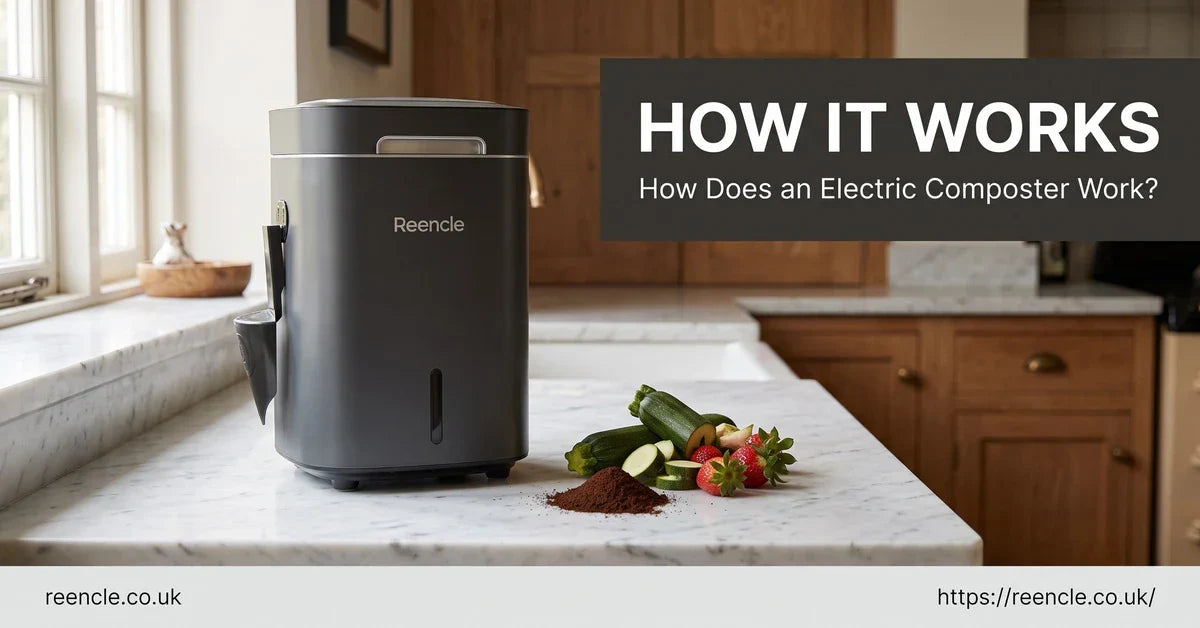
How Does an Electric Composter Work? The Real Difference Between Dehydrators and Microbial Composters (UK Guide)
Not every electric composter produces compost. Before you spend £200-£400, here is what is actually happening inside the machine, why it matters for your garden, and how to tell the difference between a dehydrator and a genuine microbial composter.
 If you've searched "how does an electric composter work" and come away more confused than when you started, you're not alone. The term covers two completely different types of machines that produce distinct outputs. One dries and grinds your food waste into a shelf-stable powder. The other uses a living colony of bacteria and fungi to biologically decompose your kitchen scraps into something that actually functions like garden compost. Knowing which type you're looking at is the most important call you'll make in this category.
Roughly 60% of all UK food waste happens in our homes, and the average household throws away hundreds of pounds of food every year. An electric composter can help redirect some of that waste. But buy the wrong type and apply its output directly to a raised bed of tomatoes or your balcony herbs, and you may damage your plants rather than feed them. This guide explains the science clearly, sets out what each type actually produces, and explains why the distinction matters specifically for UK gardeners. If you are also weighing up whether a Reencle is worth the cost compared to other approaches, the process difference is the place to start.
Contents
What "electric composter" actually means: two machines, not one
The phrase "electric composter" is applied very loosely in marketing. It gets used for two distinct machine categories: dehydration-based machines, which use heat and mechanical grinding to dry and reduce the volume of food waste (examples include the Mill kitchen system, Lomi, and the Vitamix FoodCycler), and microbial composters, which use live microbial cultures and controlled aerobic conditions to biologically decompose food waste, with Reencle being the primary example available to home users. If you want a side-by-side cost and performance breakdown, our Reencle vs Lomi vs Sage comparison covers the key figures in detail.
The outputs are not equivalent. One produces dried, sterilised food waste. The other produces material that has undergone real biological transformation, the beginning of actual compost. This is not a marketing distinction. It is a scientific one.
It matters especially in the UK, where a growing number of people without outdoor garden space are looking to electric composters as a practical alternative to a traditional compost bin. If you live in a flat in Leeds or a terrace in Bristol with only a windowsill or small balcony, the type of output you get determines whether it's useful to you at all.
How dehydrating composters work (and why their output is not compost)
Dehydrating machines operate on a straightforward principle. They use heat and sometimes mechanical grinding to remove moisture from food waste, reducing its volume by 80-90%. The output is dried, sterilised food waste. It is not compost.
The process is quick, typically completing a cycle in 4-8 hours. The systems can reduce the volume of food waste by up to 90%, using an outside heat source, as most food waste possesses a great deal of moisture. The result looks like dark, crumbly flakes or a fine powder. It smells relatively neutral. It takes up far less space than the original food scraps. From a volume-reduction standpoint, these machines work exactly as described.
The problem is what the material actually is after processing. The high temperatures used in dehydration units and the loss of moisture work to essentially eradicate microbial life in the material. This was confirmed by DNA sequencing of a dehydrated food sample, which identified no measurable microbial DNA in the output. No microbial DNA means no live microbes and no microbial stabilisation.
The dehydrated food waste is simply shelf-stable, not properly biologically stable. That distinction is consequential: because no biological decomposition has actually taken place, the organic compounds in the original food scraps are mostly still intact. They have simply had their water removed. The drying removes the water and also concentrates the salts. When you take this dried food waste and put water back into it, the microbes in the surrounding soil are able to step right up and resume the decomposition process.
This is why dehydrator manufacturers typically give their output a proprietary name rather than calling it compost. Lomi calls its output "Lomi Earth." The Vitamix FoodCycler calls it "FCycle." Manufacturers of these machines often label their output with proprietary names rather than "compost," because technically it is not.
How microbial composters work: the aerobic process explained
Microbial composters operate on an entirely different principle. Rather than using heat to kill and desiccate food waste, they create and sustain the conditions in which living microorganisms actively break down organic matter through aerobic respiration. This is the same biological process that happens in a well-managed outdoor compost heap, run at an accelerated pace inside a controlled indoor environment. For a direct comparison of how this measures up to a traditional garden bin in practice, see our guide to Reencle vs traditional composting.
The microbes involved in aerobic composting fall into two groups: mesophilic microbes, which are active at temperatures of 10°C to 45°C, and thermophilic microbes, which are active at 45°C to 70°C. A microbial composter like the Reencle maintains conditions that keep both groups active without tipping into the temperature range that would sterilise them.
The machine monitors internal temperature and uses gentle warming when needed to stay in the range where the microbial culture is most active, roughly 40-60°C. Warm enough to accelerate decomposition, but not so hot that it kills the culture the way a dehydrator does.
Three variables matter most for aerobic composting to function correctly: temperature, moisture, and oxygen. Composting bacteria need moisture to survive, typically 40-60% moisture content in the composting mass. Too dry, and the microbes become dormant or die. Too wet, and you create anaerobic conditions. Reencle monitors and adjusts internal humidity, venting excess moisture through a carbon filter while retaining what the culture needs.
Oxygen delivery is handled by automatic periodic stirring, which aerates the composting mass and prevents anaerobic pockets from forming. When there is little air and high moisture, anaerobic composting is likely to result. Anaerobic means without oxygen. In an anaerobic process, fermentation results in the formation of ammonia-like substances and hydrogen sulphide, which smells like rotting eggs. The anaerobic process is not recommended for backyard composting, and it is precisely what a well-designed microbial composter avoids by maintaining controlled airflow.
A layered activated carbon filter captures volatile organic compounds before any air is exhausted from the machine. This is why a properly functioning microbial composter can sit on a countertop without producing noticeable odour, even when processing meat and fish.
What the output from each type actually does to your soil
This is where the practical difference becomes visible in your garden or on your balcony.
True biological compost, produced by a microbial process, does several things simultaneously when added to soil. Home-made compost adds valuable organic matter that improves the soil's structure, aeration, and biodiversity. It can boost moisture retention in fast-draining sandy soils and aid drainage in heavy clay soils. Used as a mulch, it helps to hold moisture in the soil and slow down evaporation in summer. This is why the RHS recommends home composting as a soil improvement method, and why gardeners who use it year on year see cumulative improvements in their beds. If you want to plan your planting around the Reencle's output cycle, our post on seasonal gardening with Reencle maps out exactly when to harvest and apply.
Dehydrated material must be mixed into soil and will break down there over weeks, but it lacks the microbial richness and humus characteristics of true compost. More specifically, dehydrated food material's low pH, high organic matter content, poor stability and maturity ratings are all indications that the food material requires additional biological stabilisation before using it as a soil amendment, without having deleterious plant establishment and growth effects.
The sodium and chloride content of dehydrated food materials is two to three times higher than most yard trimmings and food waste-based composts. Since these salts are known to be damaging to seeds and seedlings, additional plant growth research is warranted.
This elevated salt content is a practical concern for UK gardeners. Salt draws water away from plant roots, leading to dehydration even when the soil appears moist. Apply fresh dehydrator output too generously to a raised bed or container, and you risk salt stress in your plants, particularly seedlings and anything grown in smaller volumes of compost such as balcony containers.
By contrast, true electric composters such as the Reencle maintain a living microbial culture inside the unit. This culture is the actual composting agent. The machine's role is to create and sustain optimal conditions for that microbial community: controlled temperature, automatic mixing, regulated airflow, and moisture management. The result is genuine biological decomposition, producing an output that carries the microbial diversity and humus formation characteristic of traditional compost.
The hidden risk of applying dehydrator output directly to plants
This tends to be underemphasised in machine reviews, but it's important enough to warrant its own section, especially for anyone with container gardens, houseplants, or raised beds.
When applied directly to soil in large quantities, dehydrated food waste can temporarily pull nitrogen from the soil as it begins decomposing, potentially harming plants rather than helping them. This is because the microbes that start breaking down the high-carbon, undecomposed organic material in the dehydrator output need nitrogen to build their own biomass. They take it from the surrounding soil. Nitrogen drawdown occurs when carbon-rich materials are added to the soil. Because these materials contain little nitrogen relative to their carbon content, the microorganisms that decompose them must draw extra nitrogen from the surrounding soil to build their biomass, temporarily tying up nitrogen in their own bodies that would otherwise be available to plant roots.
This can lead to short-term nitrogen deficiencies in plants, manifesting as yellowing leaves (chlorosis), reduced growth, and lower crop yields, if the process is not managed properly.
The safe way to use dehydrator output is to dilute it significantly into a larger compost pile or dug-in soil. It should be mixed into soil at a ratio of no more than 10-15% by volume and allowed several weeks to break down further. This is useful if you have an outdoor compost heap or large garden beds into which the material can be incorporated at depth. It is considerably less useful if you are a flat-dweller with a few patio pots, hoping to feed your tomatoes through summer.
For context, real-world customer reviews note that buyers who switched to a microbial unit did so specifically because they found dehydrator output did not perform the way they expected in the garden. The output difference is noticed in practice, not just on paper.
How the Reencle microbial process works, step by step
Reencle's approach is to maintain a permanent, self-sustaining colony of aerobic microorganisms inside a sealed, filtered unit that sits on your kitchen worktop or fits under a cabinet. Microbial composters use live cultures of bacteria and fungi to biologically decompose food waste through aerobic respiration. The output is material that has undergone genuine biological transformation, real compost after a curing period. Reencle is the primary example in this category available in the UK.
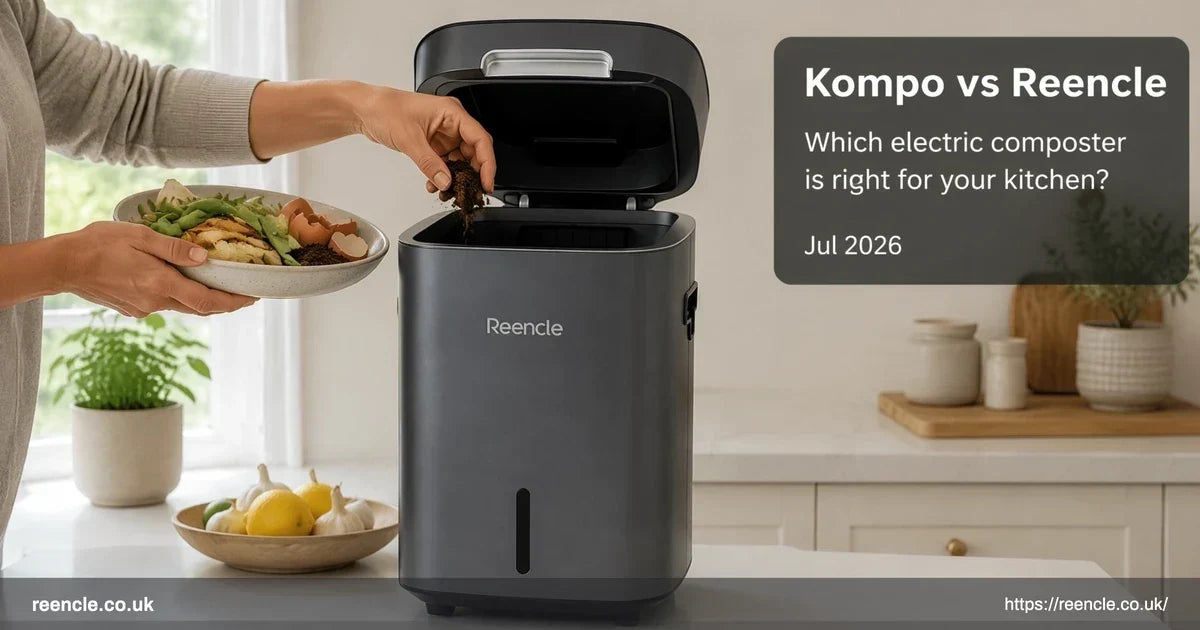
The process works as follows. You add food scraps directly to the unit at any time: courgette ends, strawberry tops, coffee grounds, leftover pasta, fish skin, leftover chicken. Microorganisms break down waste continuously, with no buttons and no waiting. The machine runs automatically, using its integrated paddle to mix and aerate the composting mass at regular intervals. Power consumption is 1.25 kWh per day, working out to roughly 32.6p a day at the current Ofgem Q3 2026 rate of 26.11p/kWh. Annualised, this comes to £119.13 per year in electricity, which is significantly lower than dehydrating models that use high-heat batch cycles.
Over time, the microbial colony processes the food scraps continuously. You empty the Reencle once every 1-3 months, depending on use. The material you remove at that point is not yet finished compost. A curing period of 2-4 weeks in a sealed container or bag after removing the output from the unit allows maturation to complete and results in a richer final product. After curing, you have material you can use in raised beds, dig into borders, mix into potting compost for containers, or give to an allotment neighbour. For city-dwellers wondering what to do with the output without a garden, our guide to composting in small spaces covers balcony pots, community gardens, and other practical options.
The unit produces zero odour or bugs thanks to Reencle's 3-layer filtering system. Included with purchase is a lab-tested self-perpetuating microbe colony and a long-lasting carbon filter.
The microbe colony is self-perpetuating under normal use. As long as the machine operates within normal parameters and you feed it regularly, the colony sustains itself without replacement. If the machine is left inactive for an extended period, periodic top-ups of the microbial base material are available to refresh the culture. Under normal daily use, however, you do not need to replace the microbes at all: the same colony that came with your unit keeps working indefinitely.
Quick Reference
Dehydrator vs microbial composter: what you actually get
| Feature | Dehydrating composter (e.g. Lomi, FoodCycler) | Microbial composter (Reencle) |
|---|---|---|
| Process | Heat and grinding removes moisture | Living aerobic microbes biologically decompose organic matter |
| Output type | Dried, sterilised food waste | Biologically active material (genuine compost after curing) |
| Microbial life in output | None (sterilised by high heat) | Active microbial community intact |
| Cycle time | 4-8 hours per batch | Continuous (harvest every 1-3 months) |
| Curing required before use | Weeks to months in soil before breakdown completes | 2-4 weeks in a container before garden application |
| Safe for direct container use | No. Dilute to max 10-15% in soil, allow several weeks | Yes, after curing period, at up to 20% by volume |
| Salt risk to seedlings | Higher (concentrated salts from dehydration) | Lower (biologically stabilised output) |
| Can improve soil structure | Not directly (must decompose further in ground) | Yes, once cured |
| Running cost (UK electricity rates) | Lower per cycle but batch-only; filters replaced frequently | Approx. 32.6p per day continuous (£119.13/year); carbon filter lasts 1 year |
| Best suited for | Reducing food waste volume for landfill diversion or adding to an existing outdoor compost heap | Producing usable garden compost with no outdoor space required |
Why what comes out of the machine is not a minor detail
The confusion between dehydrators and genuine microbial composters is not just a consumer education problem. It's documented in composting engineering and horticulture literature, and the practical implications for UK gardeners are specific and well-understood.
As BioCycle's own reporting on this puts it, "having this definition is a critically important framework as manufacturers and marketers of new technologies to process food waste either claim or imply that the output from food waste dehydrators is compost or can be used in the same way as compost." The professional composting community has been pushing back on this conflation since dehydrating kitchen appliances began being sold under the composter label. The core issue, as composting science makes clear, is whether biological transformation of organic matter actually occurs inside the unit, or whether it is simply physical reduction through drying and grinding.
From a UK gardening perspective, what the RHS classifies as garden compost is a soil improver made from decomposed organic matter. It is added to soil to improve its fertility, structure, and water-holding capacity. Dehydrated food powder does not meet this definition. It is undecomposed organic matter in a dried state, and applying it to soil initiates a decomposition process rather than concluding one.
For gardeners specifically, "Compost is the beginning of the process of humus creation," explains Colin Skelly, a Master Horticulturist. "Adding compost to your soil as mulch annually means that the humification process is ongoing and that soil health is optimised. Over time, this will ensure that plant nutrients are in good supply and that moisture holding and drainage are improved." Dehydrated food material cannot initiate this humus-building process until it has completed decomposition in the soil, a process that takes additional weeks and depends on adequate moisture and soil microbial activity being present. In a wet British winter this may happen reasonably quickly, but in a dry summer in a container with limited soil volume, it can cause the nitrogen and salt problems described above.
The practical upshot: if you garden in the UK and want a machine that produces an output you can actually use in your beds, pots, or on your lawn, the biological composition of that output is not a minor technical detail. It determines whether your investment produces garden compost or just a smaller bag of food waste to dispose of differently.
FAQ
Common Questions
Does an electric composter actually make real compost, or is it just a dehydrator?
It depends entirely on the type. Dehydrating models such as Lomi and the Vitamix FoodCycler use heat and grinding to remove moisture from food waste. The output is dried, sterilised food waste, not compost. Microbial models such as the Reencle use a living colony of aerobic bacteria and fungi to biologically decompose food scraps, producing an output that, after a 2-4 week curing period, functions as genuine garden compost. The two types are fundamentally different processes.
Is it safe to put dehydrator output straight onto my garden or houseplants?
Not directly and not in large quantities. Dehydrator output has elevated salt levels from the concentration process, and when added to soil it begins decomposing for the first time, temporarily drawing nitrogen away from plant roots in the process. It should be mixed into soil at no more than 10-15% by volume and left several weeks before planting into it. Apply it generously to seedlings or container plants and you risk yellowing leaves and stunted growth. Microbial composter output, once cured, does not carry these same risks.
How much does the Reencle cost to run in the UK?
The Reencle uses 1.25 kWh per day. At the current Ofgem Q3 2026 electricity rate of 26.11p/kWh, this works out to approximately 32.6p per day, or roughly £9.93 per month, totalling £119.13 per year. The carbon filter included with the machine lasts 1 year. Unlike dehydrating composters that run high-heat batch cycles, the Reencle operates continuously at low power, which keeps running costs lower over the long term. If you're comparing ongoing costs, also factor in that dehydrator filter replacements tend to be more frequent and batch pods, where required, add further cost per cycle. Our detailed Reencle cost savings breakdown covers the full financial picture.
What can I compost in a microbial electric composter that I cannot put in a traditional compost bin?
The key advantage is that microbial electric composters like the Reencle handle meat, fish, dairy, and cooked food, all of which attract pests in outdoor bins and are typically excluded from standard composting guidance. This means the orange peel from your morning juice, the leftover salmon from Friday night, the chicken bones from a roast, and the mouldy yogurt at the back of the fridge can all go in. For a UK household cooking from scratch regularly, this covers the majority of kitchen waste that would otherwise go to the food caddy or general bin.
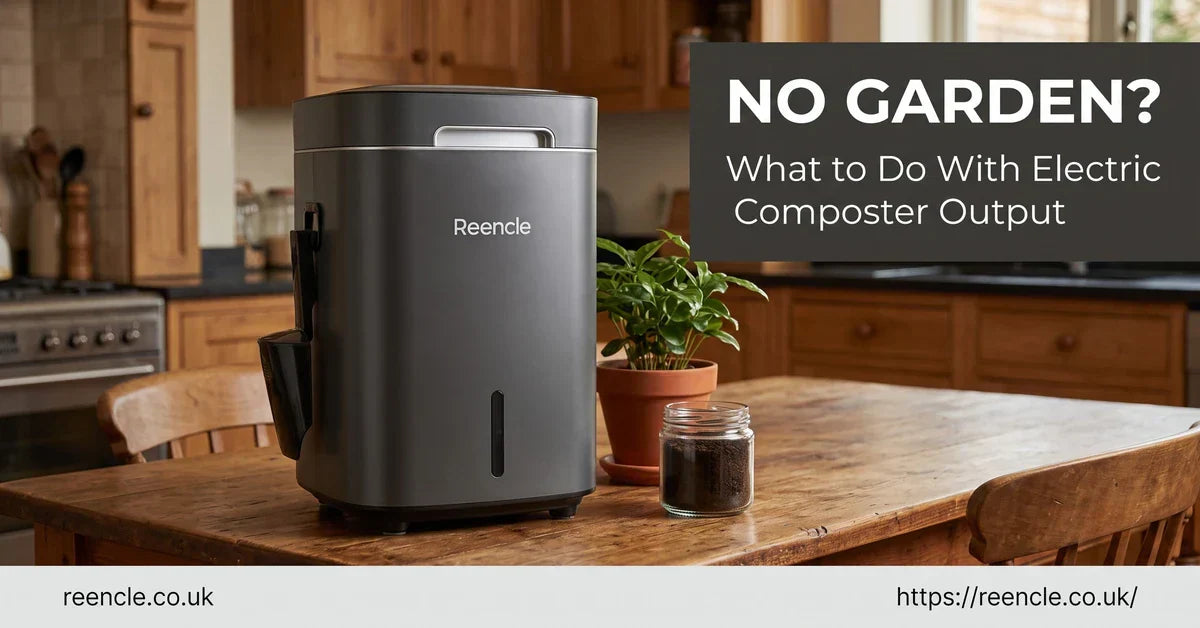
What do I do with the output from a microbial composter if I do not have a garden?
Several practical options exist. After the 2-4 week curing period, the output works in balcony pots and window boxes mixed into existing potting compost at up to 20% by volume. Community gardens and allotments will often accept finished compost as a donation. Neighbours with gardens are frequently glad to receive it. You can also add it to your council green waste bin in most areas, where it will be processed at a composting facility. The output from a microbial composter is stable, earthy-smelling, and easy to handle, unlike raw food scraps. Our composting in small spaces guide has further ideas for flat-dwellers and urban households.
How long does it take for a microbial electric composter to produce usable compost?
The machine processes food waste continuously, so there's no fixed cycle time. You harvest the accumulated material every 1-3 months depending on how much you add. The harvested output then needs 2-4 weeks of curing in a sealed container or bag before it's ready for garden use. This allows the microbial activity to stabilise and the material to reach the maturity level where it benefits rather than stresses plant roots. Total time from food scrap to garden-ready compost is therefore 6-14 weeks, depending on harvest frequency.
The bottom line
The difference between a dehydrator and a microbial composter is not a detail; it is the whole point. Only one type produces output that is genuinely useful in a UK garden.
And what about all those scraps? Without a microbial composter, the food this post is about- courgette ends, strawberry tops, coffee grounds, fish skin, leftover pasta, and the sad yoghurt at the back of the fridge- all head to landfill by default, where they generate methane rather than anything useful. The Reencle intercepts all of it. Its living microbe colony processes each type continuously, without batch cycles or dried powder as the result. After a short curing period, what comes out is garden-ready compost you can dig into raised beds, mix into balcony pots, or pass to a neighbour with an allotment. Running costs are around 32.6p a day (£119.13 a year at current Ofgem rates); the microbes sustain themselves under normal use, and there is no nitrogen drawdown risk from the output. Whether you have a garden or just a windowsill, the scraps that used to go in the bin become something your plants can actually use.
See the Reencle in action →

Leave a comment
This site is protected by hCaptcha and the hCaptcha Privacy Policy and Terms of Service apply.