
Kompo vs Reencle: Which Electric Composter Is Right for Your UK Kitchen?

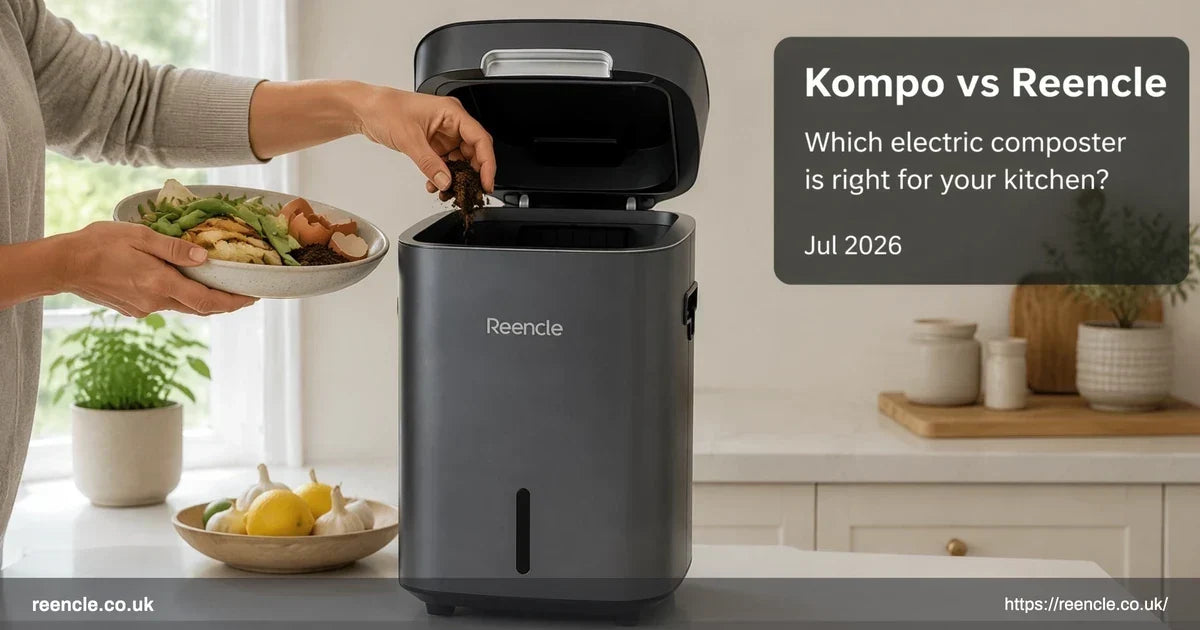
Charcoal grey electric composter on a white kitchen counter with hands adding vegetable scraps to the lid.
Home Composting

Kompo vs Reencle: Which Electric Composter Is Right for Your UK Kitchen?


Kompo landed on Dragon's Den promising to shrink your food waste in hours. It does. But shrinking waste and actually returning it to the soil are two different environmental outcomes, and only one of these machines finishes that second job.

By Bev Barraca · 21 July 2026

Dark charcoal grey electric composter on a white worktop with fresh vegetable scraps beside it.Dark charcoal grey electric composter on a white worktop with fresh vegetable scraps beside it.If you watched Kompo pitch on Dragon's Den back in March, you've probably already typed "does Kompo actually make compost" into a search bar and got nowhere useful. Fair question. £225 is a real amount of money for a kitchen appliance, and it's worth knowing what it actually does before it arrives. Kompo and Reencle are solving the same problem: food waste with nowhere to go in a flat or small house, but they do genuinely different things to what you put in them, and that difference has a real environmental consequence. Drying and shrinking food waste keeps it out of a landfill bag, which matters. But it's only half the environmental job. Finishing the biological breakdown so the waste actually becomes compost, something that returns nutrients and organic matter to soil rather than sitting in a bin bag as stabilised material, is the other half, and only one of these machines completes it.

Method 01

What Kompo actually does to your food waste

Kompo dries and grinds food scraps over four to eight hours, sometimes up to twelve depending on what's inside. Controlled heat and airflow pull the moisture out, then it grinds the result into what the company calls "Kompo Mix", a soil-like material. Kompo's own product page is honest about this part: it's not finished compost. The company describes the process as accelerating "the first two stages" of composting indoors, not completing it. Worth knowing before you open the lid expecting something ready for your pots.

Key takeaway: Kompo dehydrates and grinds food waste into a stable, odour-reduced material. It does not fully compost it, so on its own it doesn't return organic matter to soil, only reduces landfill volume.
Method 02

What Reencle does differently

Reencle runs on a continuous process using aerobic microorganisms, branded ReencleMicrobe, that actually break the food waste down biologically rather than drying it out. You keep adding scraps daily, and the machine keeps working on whatever's already inside. After around thirty days of curing, what comes out is usable as real garden compost, not a stabilised waste product waiting for a second stage. This is the environmental difference that matters most. Drying food waste keeps methane from forming in landfill, which is genuinely useful, but it stops there. Finishing the process into compost closes the loop properly: the carbon and nutrients in that food waste actually go back into soil, feeding plants and improving soil structure, instead of ending as inert dried matter that still needs somewhere to go. If you want the fuller picture of how that biological process works, see what composting actually is.Two column infographic comparing a dehydrator style composter's dried output against a microbe based composter's cured compost.

Key takeaway: Reencle produces cured, ready-to-use compost after about thirty days, because microbes finish the biological process. That's what actually returns nutrients to soil, not just reduces waste volume.
Method 03

Running costs: Kompo vs Reencle side by side

Kompo runs each cycle at roughly 0.7 kWh, which the company estimates at around 20p per cycle. Assuming daily use, that's roughly £73 a year in electricity. Add a twin pack of dual charcoal filters at £24.99 lasting six to twelve months, and total running cost lands at roughly £98 to £123 a year. Reencle draws around 52 watts and runs continuously rather than in discrete cycles. At the current Ofgem price cap unit rate of 26.11p per kWh, that works out at around £110 a year in electricity alone, which is what Reencle's own cost breakdown states too. Add the carbon filter (£35, typically replaced every 9 to 12 months), and Reencle's realistic ongoing cost is closer to £145 a year from year two onwards. The mesh filter (£12) is washable and reusable rather than an annual buy, and the ReencleMicrobe starter (£20 to £35) rarely needs topping up, since the microbes are self-replicating and can last semi-permanently with proper care. Budget for those two only occasionally, which can push a given year closer to £160 to £180.

Key takeaway: Kompo is cheaper to run as well as to buy. Reencle's ongoing cost is higher once you count the filters and microbe top-ups, so the trade you're making is running cost for finished compost, not the other way round.
Method 04

Capacity and how much waste each one handles

Kompo's bucket holds 3 litres and claims to cut that volume by up to 80% per cycle. That suits smaller households, or anyone processing scraps in batches rather than daily. Reencle is built around continuous daily additions instead of a fixed bucket you fill and empty, which suits households generating food waste every day rather than in occasional batches.

Key takeaway: If your household cooks daily and generates waste continuously, a continuous system fits better than a batch bucket.
Method 05

What to do with the output if you don't have a garden

This is the practical blocker most flat dwellers hit before they've even compared machines. Kompo's dried Kompo Mix needs further breakdown before it's safe to use directly around plant roots, since it's only completed the first two stages of the process, and the RHS's own composting guidance is clear that partially decomposed material should be fully rotted down before use around edible plants. Reencle's cured output, after the thirty-day cure, is closer to ready-to-use compost. Either way, if there's no garden, the routes are much the same: top up your council food waste caddy with it, offer it to a neighbour with an allotment, ask a local community garden if they'll take small drop-offs, or use it on balcony pots once it's properly cured.Dark crumbly cured compost being added to a terracotta pot of herbs on a UK flat balcony.

Key takeaway: Check which stage your machine's output is actually at before putting it anywhere near edible plants.
Method 06

Noise, smell, and living with each machine day to day

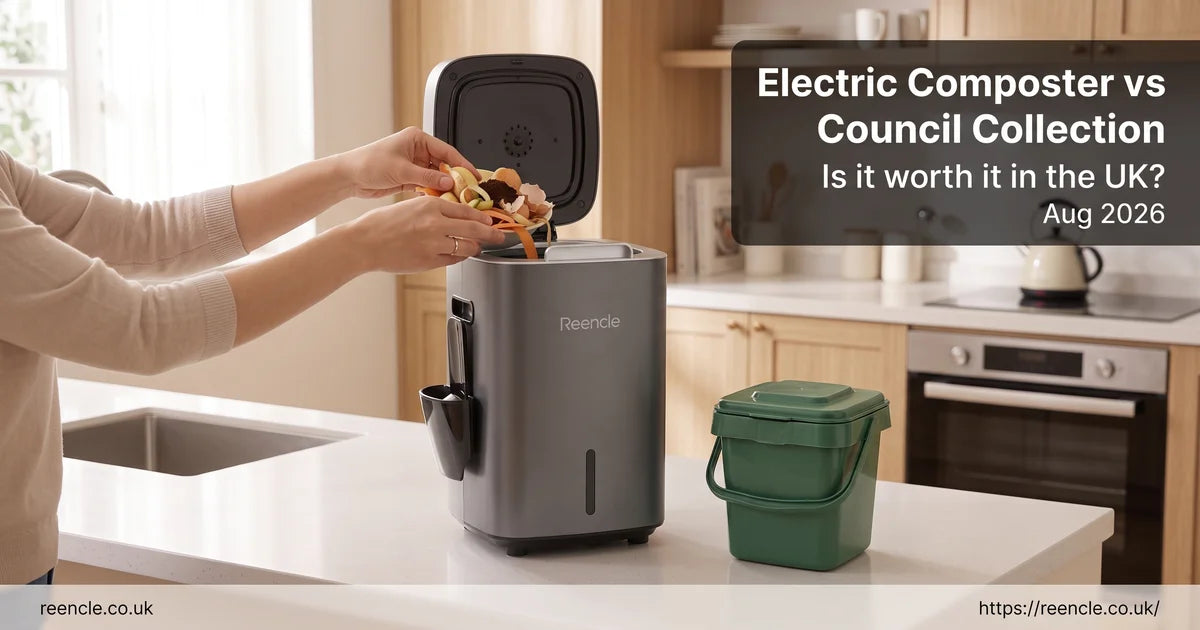
Kompo relies on its dual charcoal filter to contain smell during grinding and dehydration, and those filters need replacing every six to twelve months to keep doing their job. Reencle's continuous microbial process is generally reported as producing a milder, earthier smell on opening rather than a food waste smell, which matters more than you'd think when the machine's sitting on your counter rather than tucked in a cupboard.Dark charcoal grey electric composter sitting on a kitchen counter beside a kettle and fruit bowl.

Key takeaway: Both machines are built to live on a kitchen counter, but they control odour through different mechanisms with different upkeep.
Method 07

What early buyers are actually saying about Kompo

Kompo's own FAQ doesn't dodge the core question. It states plainly: "Kompo stabilises and dehydrates food waste to create a dry Kompo mix. Traditional composting takes 30 to 60 days outdoors. Kompo accelerates the first 2 stages of that process indoors in hours, reducing volume and preventing methane-producing breakdown." That's honest marketing, and reviews of the machine itself back it up. Buyers who've received one generally describe it as quiet and free of the smell they expected.

The rougher edges show up around getting one in the first place. Kompo's Trustpilot page carries a real pattern of long delivery delays, with some buyers reporting waits of several months against repeated "it's shipping soon" messages, plus slow email support once something goes wrong. At least one reviewer also reported the internal coating on the bin and grinding arm wearing after around two weeks of regular use, despite eggshells being about the toughest material they'd put through it. That's a single reported case, not a proven pattern, but Kompo is a young, Dragon's Den era product without years of independent use behind it yet, so it's worth weighing alongside the price.

Key takeaway: Kompo's process claims check out against its own FAQ. The open question is fulfilment and long-term durability, not what the machine does to your food waste.

Quick Reference

Kompo vs Reencle at a glance


Feature Kompo Reencle
Process Dries and grinds (dehydrator) Aerobic microbes (biological breakdown)
Output Not finished compost Cured compost, approx. 30 days
Cycle 4 to 8 hours (up to 12 h), batch-based Continuous, daily additions
Capacity 3 litre bucket Designed for ongoing daily use
Running cost (est. per year) Approx. £98 to £123 (electricity + filters) Approx. £145 to £180 (electricity + filters, occasional microbe top-up)
Consumables Charcoal filter twin pack, £24.99, every 6 to 12 months Carbon filter £35, roughly annual. Mesh filter £12 is washable and reusable, not an annual buy. ReencleMicrobe starter £20 to £35 is self-replicating and rarely needs topping up
Price From £225 £425
Warranty 12 months 12 months
Did You Know

Why the environmental outcome, not just the waste reduction, is the real comparison

UK households waste an average of £470 worth of food every year, and most of it ends up either in landfill, producing methane as it breaks down without oxygen, or in a council food waste caddy that a lot of people never see the end result of. If you want more ways to cut that figure before it ever reaches a composter, we've covered practical food waste reduction habits separately. Every electric composter's real job is stopping that methane-producing landfill cycle. Kompo does the first part well: drying and shrinking waste stops it rotting anaerobically in a bin bag. But stabilised dried waste still isn't compost, and depending what happens to it next, its environmental benefit can stop right there. Reencle finishes the job. The same food waste that would have produced methane in landfill instead becomes cured compost that goes back into soil, feeding plants and building soil structure rather than just disappearing more tidily. That's a materially better environmental outcome than waste reduction alone, and it's the main reason Reencle costs more to buy and to run: it's not just drying the problem away, it's actually closing the loop.Stat graphic showing UK households waste £470 of food a year, illustrated with a row of grocery icons.

Sources: WRAP, Ofgem, RHS

FAQ

Common Questions


Does Kompo actually make compost, or is it just a dehydrator?

Kompo dries and grinds food waste rather than composting it fully. Its own product page describes the process as completing only the first two stages of composting, producing a stabilised "Kompo Mix" rather than finished compost ready for plants.

Is a Reencle composter worth it if I don't have a garden?

Yes, if you have somewhere to use or donate the cured output. Reencle's compost is ready to use after around 30 days, and can go into balcony pots, a neighbour's garden, a community garden, or top up a council food waste collection.

How much does it cost to run an electric composter in the UK?

Kompo costs roughly £98 to £123 a year including its filter. Reencle costs more to run overall, roughly £145 to £180 a year once you include its carbon filter and occasional mesh filter or microbe starter top-ups, based on Reencle's own published cost breakdown.

Does an electric kitchen composter smell?

Both Kompo and Reencle are designed to control odour indoors, Kompo through dual charcoal filtration and Reencle through its enclosed microbial process, which tends to produce a mild, earthy smell rather than a food waste smell on opening.

What's the difference between Kompo and Reencle's output, environmentally?

Kompo's output is dried and ground food waste that still needs further breakdown before it returns any real benefit to soil. Reencle's output is cured for about 30 days into compost that actively feeds soil and plants, which is a materially better environmental outcome than waste reduction alone.

How long does Reencle take to produce usable compost?

Reencle's continuous process typically needs around 30 days of curing time after food waste has been broken down before the output is ready to use as compost.

Is Kompo reliable, based on early reviews?

The machine itself is generally praised as quiet and free of smell. Trustpilot reviews show a real pattern of long delivery delays and slow customer support, plus at least one report of the internal coating wearing after around two weeks of use. As a young, Dragon's Den era product, it doesn't yet have years of independent durability data behind it.

🌱

The bottom line

Kompo and Reencle both keep food waste out of landfill, but only one of them finishes the job environmentally, turning that waste back into compost that actually feeds soil rather than just sitting there dried and stable.

And the scraps? Even a tidy kitchen still ends up with the bits neither machine advertises well: vegetable peelings, eggshells, coffee grounds, the last third of a punnet of berries that went soft before you got to them. Left in a normal bin, all of that heads to landfill and produces methane as it breaks down without oxygen. A Reencle handles cooked food, meat, and dairy alongside the raw scraps, then cures it into compost you can actually use on plants, not just a stabilised waste product waiting for a second stage.

See how Reencle works →
Reading next

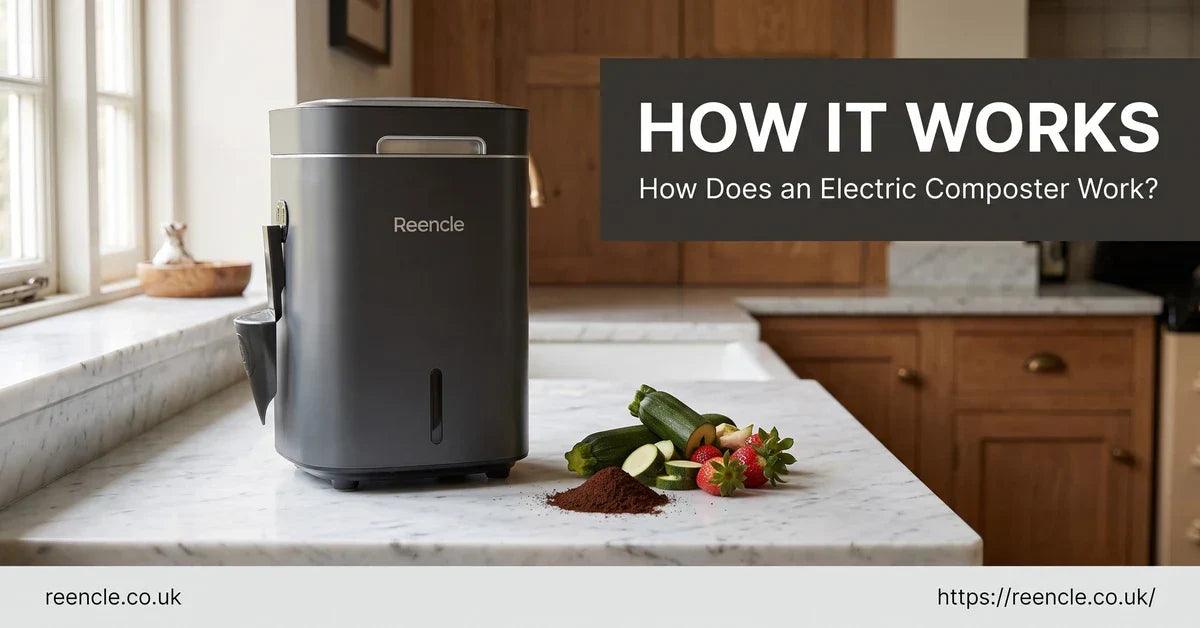
Dark-grey Reencle electric composter on a white kitchen worktop with vegetable scraps — how does an electric composter work

Leave a comment

This site is protected by hCaptcha and the hCaptcha Privacy Policy and Terms of Service apply.