Home Composting
Electric Composter vs Council Food Waste Collection: Is It Worth It in the UK?
More than half of UK households have no working council food waste collection. Here's what an electric composter actually costs against that gap, worked out in full.
By Bev Barraca · 27 August 2026
If you've typed "is an electric composter worth it" into a search bar, the answer you get usually assumes you already have a council food waste caddy under your sink.
For a lot of UK households, that assumption is just wrong. WRAP surveyed over 5,500 UK adults in 2025 and found only 42% have a food waste collection service and actually use it.
A further 14% have access and don't bother, and 38% have no service at all (WRAP, Household Food Management Survey 2025).
That's over half the country outside the "just use the caddy" default most advice starts from.
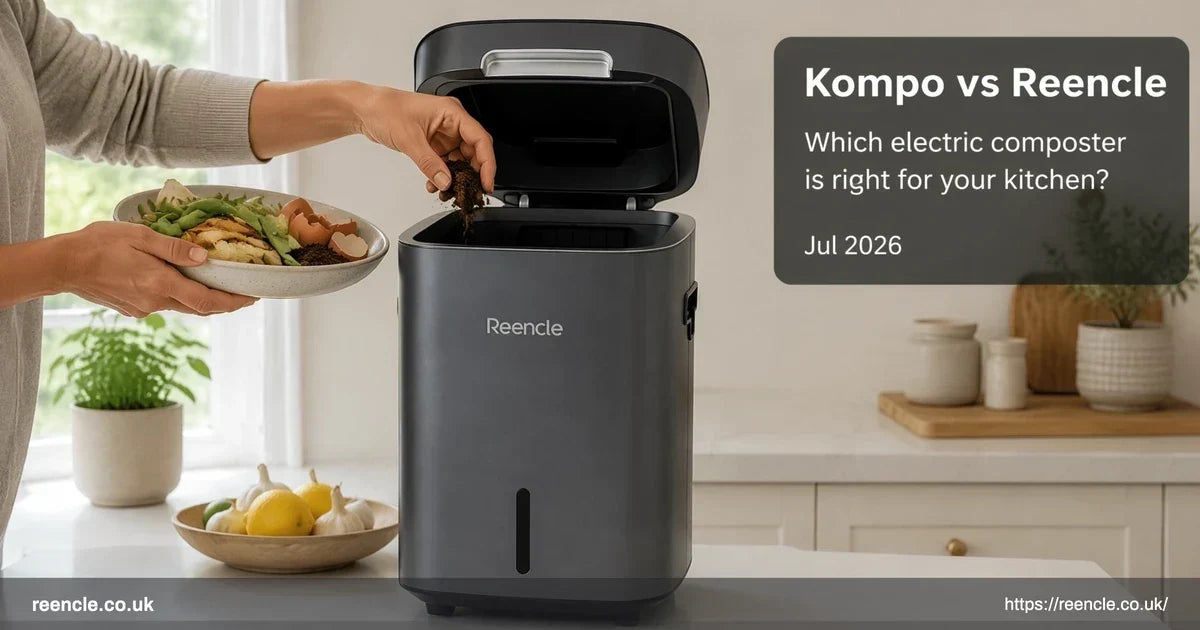
This post works through what a Reencle electric composter actually costs to buy and run, at current prices and the current Ofgem rate, so you can weigh it against your own situation instead of a generic one.
Method 01
Do you actually have a working council collection?
Nearly four in five English households say they haven't seen or heard anything about planned universal food waste collections, even with reforms already rolling out (WRAP, Household Food Management Survey 2025). Usage is higher in Wales and Northern Ireland than in England, too, so where you live matters almost as much as whether a scheme technically exists on paper.
Simpler Recycling reforms should bring weekly food waste collections to roughly four in five English homes from 31 March 2026. But WRAP's own reporting is blunt about it: the rollout is uneven and still incomplete (WRAP press release, 9 March 2026).
If you're not sure which group you're in, check your council's website directly. Don't assume coverage has caught up with the deadline just because the deadline has passed.
Key takeaway: Over half of UK households have no working food waste collection right now, whether because none exists or because they don't use the one they have.
Method 02
What Reencle costs to run, worked out in full
Reencle Prime draws 1.248 kWh a day on average. At the Ofgem Direct Debit rate for 1 October to 31 December 2026, 26.32 pence per kWh, that's £0.328 a day (Ofgem, Energy price cap unit rates and standing charges).
Over a year, that's £119.86 in electricity alone, or £9.99 a month. Add one carbon filter a year, around £35, and the running total comes to £154.86 a year.
That rate moves every quarter, so take this figure as accurate for the current Ofgem period only, and check it again after 31 December 2026. For the full month-by-month working, see our dedicated electric composter running costs guide.
Key takeaway: Running a Reencle Prime costs £9.99 a month in electricity, or £154.86 a year including one carbon filter, at the current Ofgem rate.
Warning: Electricity unit rates move every three months under the Ofgem price cap. A running cost figure with no rate and no date attached is already out of date.
Method 03
What Reencle costs to buy
The Reencle Prime is £425. The larger Reencle Gravity Pro, which has a built-in scale display and app connectivity, is £599.
Neither price comes back through a council scheme, obviously. But both come with a 60-day free return and a 1-year warranty, so there's a real trial window if you're not sure the routine will actually stick in your kitchen.
Key takeaway: Buying in is £425 for the Prime or £599 for the Gravity Pro, both with a 60-day return window to test the routine before committing.
Method 04
If your council already collects, is Reencle still worth it?
If you're in the 42% with a working collection you actually use, an electric composter isn't solving a coverage problem for you. It's solving a different one: turning scraps into something usable for pots or a garden within about a month, rather than sending them off to be processed elsewhere.
Reencle's cycle breaks waste down in about 24 hours, but that figure is volume reduction, not finished compost. Compost you can dig into soil takes roughly 30 days in total: the 24 hours plus about 3 weeks of curing (Reencle, How It Works).
If your caddy collection is genuinely convenient and you have no interest in the output yourself, the case for buying one is weaker.
If you want the compost, or your collection is patchy in practice despite existing on paper, the maths changes. For a broader look at the question outside this specific comparison, see our general electric composter worth-it guide.
Key takeaway: A working council collection removes the coverage problem, but not the question of whether you actually want usable compost out the other end.
Method 05
No collection at all? What changes
For the 38% with no service, and the 14% who have one but skip it, this isn't really "caddy vs composter". It's landfill vs composter, because there's no working middle option collecting the food waste at all right now.
UK households throw away roughly £1,000 worth of food a year for a household of four, based on WRAP's national total of around £17 billion annually (WRAP, Food Waste Action Week 2026 press release, 9 March 2026). That figure covers all avoidable food waste, not what a composter would save you, so don't treat it as a return-on-investment number. It's simply the scale of what's currently being thrown away with no diversion route at all.
Against that, £425 plus £9.99 a month is a concrete, bounded cost next to a food waste problem that otherwise has nowhere to go but the bin.
Key takeaway: With no council collection to fall back on, the comparison is between landfill and a bounded, known cost, not between two collection options.
Method 06
No garden? What happens to the compost
Not having outdoor space is a real practical question, not a small one. Reencle's finished output, once it's had its roughly 3-week curing period, can go into pots, a balcony planter, or to a neighbour or community garden if you don't have growing space of your own.
Uncured output shouldn't go straight onto roots or seeds. It can cause root burn before it's actually finished. For a fuller walkthrough, see our guide on what to do with Reencle output if you have no garden.
Key takeaway: No garden doesn't rule Reencle out. Pots, balconies, and community gardens all work for the finished, cured compost.
Method 07
What can and can't go into Reencle
Reencle processes fruit and vegetable scraps, citrus peel, raw and cooked meat and seafood trimmings, dairy, modest amounts of cooked food like rice and pasta, coffee grounds, and paper tea bags with the staples removed.
Small, soft, cooked bones are fine too: cooked fish bones and small cooked animal bones, as long as they're soft enough to break apart by hand (Reencle official support site).
What it won't take: hard, large, or uncooked bones, large stones like avocado or mango pits, anything non-food such as plastic or produce stickers, garden waste, or chemicals and medication (Reencle official support site).
Key takeaway: Reencle handles most everyday kitchen scraps, including small soft cooked bones and dairy, but not hard or uncooked bones, large pits, or anything non-food.
Quick Reference
Reencle cost and coverage at a glance

| Situation |
Value |
| UK households with a working council collection they use |
42% |
| UK households with access but not using it |
14% |
| UK households with no service at all |
38% |
| Reencle Prime purchase price |
£425 |
| Reencle Prime running cost, electricity only |
£9.99/month, £119.86/year (Ofgem rate 26.32p/kWh, 1 Oct to 31 Dec 2026) |
| Reencle Prime running cost, with one annual filter |
£154.86/year |
| Time to volume reduction |
About 24 hours |
| Time to finished, cured compost |
About 30 days total |
| Average UK household of four's annual food waste cost |
£1,000/year |
Sources: WRAP, Household Food Management Survey 2025, WRAP, Food Waste Action Week 2026 press release, and Ofgem price cap. Reencle prices from reencle.co.uk.
Expert Insight
The coverage gap most advice ignores
Generic advice on electric composters tends to assume every reader already has a working council caddy and is only weighing up convenience. WRAP's own 2025 survey says otherwise. 38% of UK households have no food waste collection service at all, and a further 14% have one they don't use. That's 52% of the country for whom "just use your council collection" isn't a real option, whether the service doesn't exist where they live or it just doesn't work for them in practice.
Simpler Recycling reforms are meant to close that gap for most of England from 31 March 2026, but WRAP is explicit that the rollout is uneven, and 76% of people in England say they haven't seen or heard anything about the planned changes. Until that changes, the coverage gap is a more useful way to frame this comparison than a generic "is it worth it".
FAQ
Common Questions
Is Reencle better than just using my council food waste bin?
It depends on whether you have a working collection. If you already use one, Reencle mainly adds usable compost rather than solving a coverage problem. If you don't, or don't use the one you have, Reencle gives food waste somewhere to go for £9.99 a month in electricity plus the upfront cost.
How much does it cost to run an electric composter in the UK?
A Reencle Prime costs £9.99 a month in electricity, or £119.86 a year, at the current Ofgem Direct Debit rate of 26.32p/kWh for 1 October to 31 December 2026. Add roughly £35 a year for one carbon filter, and the total comes to £154.86 a year.
Do I need a garden to use an electric composter?
No. Reencle's finished, cured compost, ready after about 30 days total, can go into pots, balcony planters, or be handed to a neighbour or community garden. You don't need outdoor growing space to use the output.
What happens if my council doesn't collect food waste at all?
You're not alone. 38% of UK households have no food waste collection service, per WRAP's 2025 survey. Without one, food waste generally goes to landfill rather than being diverted, which is the gap an electric composter closes at the household level.
Is an electric composter just a more expensive version of my food waste caddy?
Not quite. A caddy collects waste for someone else to deal with elsewhere. Reencle processes it in your kitchen and gives you usable compost after about 30 days, which a caddy doesn't. Whether that's worth £425 plus £9.99 a month depends on whether you have a working caddy alternative at all.
🥕
The bottom line
Whether an electric composter is worth it comes down to one question: do you actually have a working council food waste route, or not?
And the scraps? Even a full council caddy still leaves waste that never quite fits the routine, from vegetable peelings off a Sunday roast to a chicken carcass that's too big for the caddy but breaks apart easily once it's cooked down small and soft. Without a working collection, that waste has nowhere to go but general rubbish and, eventually, landfill. A Reencle turns exactly that kind of scrap into compost you can use within about a month, instead of it disappearing into a bin with no way out.
Explore the Reencle Composter →



Leave a comment
This site is protected by hCaptcha and the hCaptcha Privacy Policy and Terms of Service apply.