
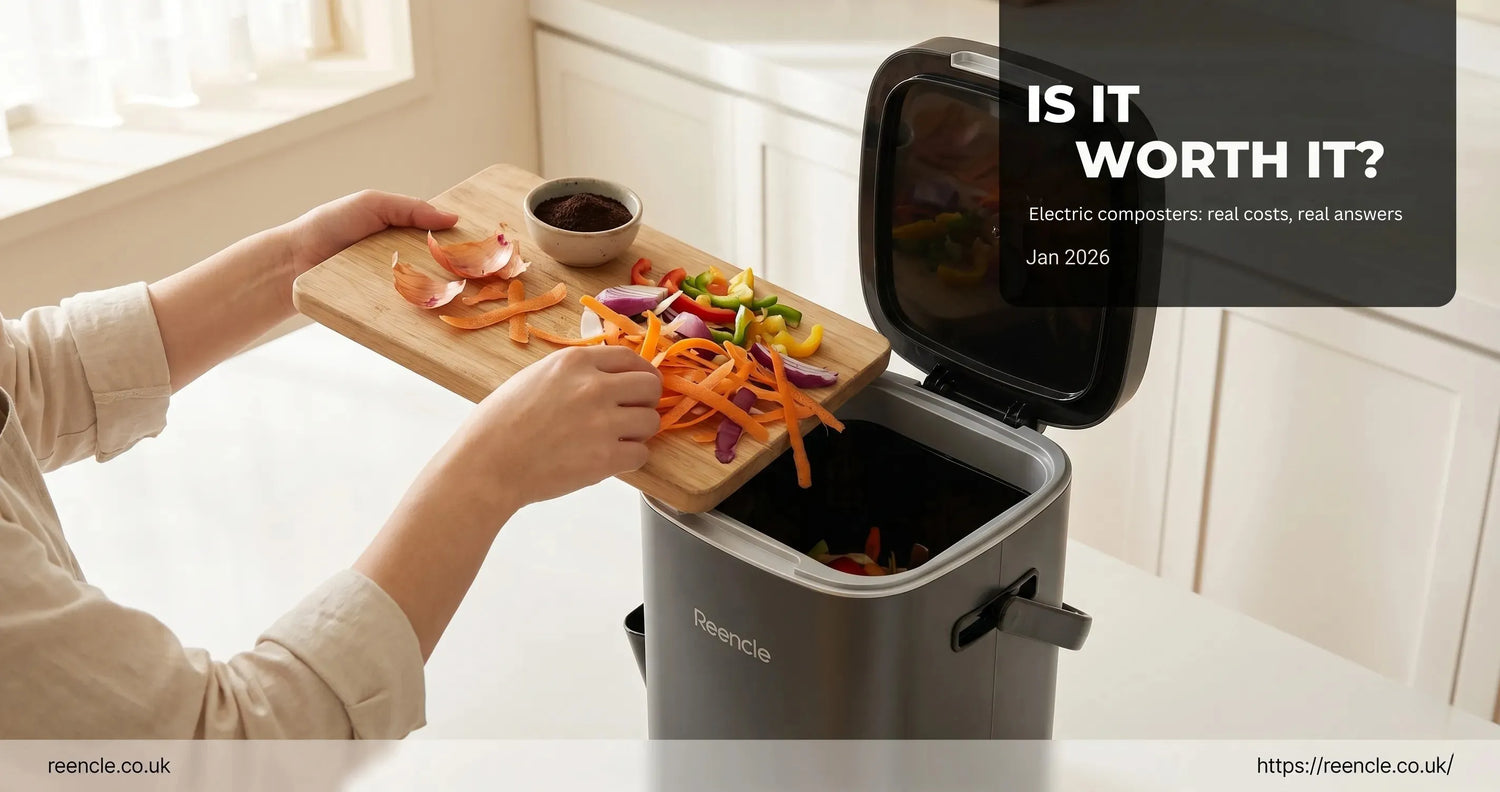
Is an Electric Composter Worth It? What UK Households Need to Know
Electric composters cost anywhere from £150 to £500+. Whether that's money well spent depends on what you're actually buying, how you'll use it, and what you expect to get out of it.
By the Reencle Team · 29 January 2026
 The price tag is usually where people stall. Spending several hundred pounds on a kitchen appliance for food scraps feels steep when there's a council caddy or a compost bin in the garden already.
But "is it worth it" isn't really a question about the receipt. It's about what the machine does, what comes out of it, and whether any of that fits your household. Some electric composters turn food waste into usable compost. Others just dry it out and grind it up. That difference matters more than most product pages let on.
Here's what actually matters when deciding.
Contents
Not All Electric Composters Are the Same
This is the single most important thing to understand before spending any money. Machines marketed as "electric composters" fall into two completely different categories. The distinction changes everything about whether the purchase is worth it.
Food waste dehydrators use heat and blades to dry, shrink, and grind food scraps into a fine powder. A cycle typically takes 4 to 8 hours. The output looks like soil, but it isn't compost. No biological breakdown has taken place. No microbial activity. The material still needs to decompose further once mixed into soil. Most machines on the market work this way. Lomi, FoodCycler, and Mill are all dehydrators.
True microbial composters maintain a living culture of microorganisms inside the unit. These microbes do the actual decomposition, the same biological process that happens in a traditional compost heap. The machine keeps conditions right: stable temperature, regular mixing, controlled airflow, managed moisture. The output is biologically active and much closer to finished compost. Reencle and GEME use this approach.
This isn't a branding difference. It's the difference between drying food and decomposing it. One produces a soil amendment that needs weeks of further breakdown. The other produces something you can use on your garden or houseplants with minimal curing.
The Real Cost Breakdown
The price on the box is only part of the picture. Ongoing costs vary hugely between machines, and the cheapest unit to buy is rarely the cheapest to own over two or three years.
Upfront cost. Dehydrators range from around £150 to £350. True microbial composters sit between £350 and £500+. The gap is real, but it narrows fast once you factor in everything else.
Electricity. A microbial composter like the Reencle draws around 52 watts on average and runs continuously. At current UK electricity rates, that's roughly £6 to £9 per month. About the same as a Wi-Fi router. Dehydrators use more energy per batch (around 1 kWh per cycle for a Lomi), but only run when you start them. Daily use brings the monthly cost to a similar range.
Filters and consumables. This is where dehydrators get expensive. Lomi needs LomiPods for its grow cycle and new carbon filters every few months. FoodCycler requires filter replacements roughly every 3 to 6 months. Over three years, those costs add £150 to £300+ on top of the purchase price. Microbial composters have fewer ongoing costs. Reencle's filter and microbe culture need less frequent replacement, keeping long-term running costs lower.
Total cost of ownership (3 years). A £200 dehydrator plus three years of consumables can easily reach £400 to £500. A £400 microbial composter with lower ongoing costs may end up at a similar total, but you get fundamentally different output for the money.
What Can You Actually Put In?
If your household cooks with meat, fish, and dairy (most UK households do), this question matters a lot.
Dehydrators handle fruit and vegetable scraps well. Most also accept bread, grains, and coffee grounds. Meat and dairy are where problems start. Greasy foods can clog blades, cause odour issues, and leave residue that's hard to clean. Some manufacturers recommend avoiding them entirely.
Microbial composters accept a much wider range. Cooked food, raw meat, fish bones, dairy, eggshells, coffee grounds. The live microbe culture breaks down proteins and fats biologically, which is exactly what dehydrators can't do well.
In practice, this matters more than it sounds. If half your kitchen waste is leftover pasta bake, chicken bones, and cheese rinds, a dehydrator won't handle your actual waste stream. A microbial composter will.
There are still limits with any machine. Large bones, cooking oil in quantity, and non-food items (tea bag staples, produce stickers, cling film) should stay out.
Does It Smell? Does It Make Noise?
These two questions come up in every review, every forum thread, every conversation about electric composters. Fair enough. Nobody wants a noisy, smelly appliance on the worktop.
Smell. Both types use carbon filters for odour control. Dehydrators can produce a noticeable cooked-food smell during drying, especially with starchy or protein-heavy scraps. Some users describe it as stale fryer grease or toasted cereal. Not unbearable, but present. Microbial composters tend to produce less smell because the microbes process waste continuously rather than heating it in one big batch. A well-maintained Reencle runs odour-free even with meat and dairy. For any machine, filter maintenance is the biggest factor. Neglect the filter and smells will get through.
Noise. Dehydrators run 4 to 8 hour cycles with fans, heating elements, and grinding blades all going at once. Users consistently report noise above fridge level, closer to a dishwasher. Running overnight with the kitchen door shut is the common solution. Microbial composters operate in shorter, intermittent mixing cycles with quiet stretches in between. Reencle sits closer to a fridge hum. Not silent, but unobtrusive enough for an open-plan kitchen.
Will It Work in a Flat or Small Kitchen?
Flats and apartments are arguably where electric composters make the most sense.
No garden for a traditional compost bin. Maybe no balcony either. Your options are the general waste bin, a council food caddy (if your area has one), or scraps piling up on the worktop until collection day.
An electric composter sits on the worktop and processes waste daily. No outdoor space needed. No trips to a compost heap. No smelly caddy under the sink attracting fruit flies.
Footprint. Most units are roughly the size of a bread bin or medium slow cooker. They fit on a kitchen worktop even in smaller kitchens.
No garden? Here's what to do with the output. If the machine produces true compost, you've got options. Houseplants and window boxes. Neighbours who garden. Community gardens and allotments. Some councils accept compost in green waste bins. If it produces dried powder (dehydrator output), your options shrink. That material needs soil to finish breaking down, which is harder without outdoor space.
What About Council Food Waste Collections?
England's mandatory weekly food waste collections started rolling out from March 2026 under the Simpler Recycling reforms. The goal is a weekly caddy service for every household in England.
The reality is patchier. Around 79 councils have transitional arrangements allowing delays. Some won't have collections running until the mid-2030s or early 2040s. If your council already collects weekly, great. If not, you may be waiting years.
Even with a council collection running, a home composter does something the caddy doesn't. The caddy sends waste to an anaerobic digestion facility. It gets processed, but you never see the result. A home composter turns the same waste into something you can use in your garden, on houseplants, or in containers. You keep the value.
There's also the practical side. A food waste caddy under the sink gets unpleasant between collections, especially in warmer months. An electric composter processes waste as you add it. Nothing sits around decomposing in open air.
What Do You Do With the Output?
Here's where the dehydrator vs microbial composter distinction hits hardest in practice.
Dehydrator output is dried, ground food material. Volume-reduced by roughly 90%, shelf-stable, easy to handle. But biologically inert. Nothing has decomposed yet. Mixed into garden soil, it will break down over several weeks as soil microbes work on it. In small amounts, it's a reasonable soil amendment. In quantity without curing, it can cause nitrogen lock-up and harm plants. Not suitable as direct plant food, potting mix, or top dressing.
True compost output from a microbial composter is biologically active. It contains the living microorganisms that broke it down. With a week or two of curing in open air, it's ready. Mix it into garden beds, add it to raised beds and containers, use it as top dressing around established plants, or blend it into potting mix for houseplants. If you grow anything at all, this is genuinely useful material.
The question to ask: do you want smaller waste, or do you want compost? If the answer is "just make it smaller," a dehydrator works. If the answer is "I want something I'll use," only a microbial composter delivers.
When an Electric Composter Isn't Worth It
Not every household needs one. Worth being upfront about that.
You already have a working outdoor compost bin. Garden space, a compost bin or heap that's ticking along, no real complaints? An electric composter adds speed and the ability to process meat and dairy. But if your current setup works, you don't need to spend £300+.
You generate very little food waste. A single person who cooks infrequently and produces a handful of peelings a week won't get enough value from any electric composter to justify the cost. These machines work best when a household generates at least a small bag of scraps daily.
You only want volume reduction. If the goal is a lighter, less smelly bin, the free council caddy (once available) does that job. A dehydrator does it faster, but at a cost of hundreds of pounds plus ongoing filters. That maths only works if the convenience genuinely matters to you.
You're on a tight budget. An electric composter is a convenience appliance. Like a dishwasher or a food processor, it does something you could do another way for less. If the upfront cost is a stretch, a bokashi bin (£20 to £40) or a wormery (£50 to £80) are genuinely effective indoor alternatives at a fraction of the price.
The best composter is the one you'll actually use. If that's a heap in the garden, brilliant. If that's an electric unit on the worktop, also brilliant. The point is keeping food waste out of landfill.
Quick Reference
Is an Electric Composter Worth It? At a Glance
| Question | Dehydrator | Microbial Composter |
|---|---|---|
| Upfront cost | £150–£350 | £350–£500+ |
| Monthly electricity | Varies by batch | ~£6–9 |
| Ongoing consumables | High (pods + filters) | Low |
| Handles meat and dairy | Limited | Yes |
| Output type | Dried powder | Active compost |
| Processing time | 4–8 hrs per batch | Continuous 24 hrs |
| Noise level | Moderate | Low |
| Works in a flat | Yes | Yes |
| Usable without garden | Limited | Yes |
| Best for | Volume reduction | Real composting |
UK Food Waste: The Numbers Behind the Decision
UK households throw away around 6.6 million tonnes of food every year. That's roughly 70% of the country's total food waste. Around 73% of it could have been eaten. The average UK household loses £470 a year to food that ends up in the bin, about 140 meals' worth.
The environmental cost adds up too. UK food waste generates approximately 25 million tonnes of CO₂ equivalent annually. Food waste in landfill decomposes anaerobically and produces methane, which is far more potent than carbon dioxide as a greenhouse gas.
England's mandatory weekly food waste collections, introduced under the Environment Act 2021, are meant to divert more waste from landfill. But the rollout is uneven. Around 79 councils have transitional arrangements, with some not expected to start until the 2030s or early 2040s. Millions of households are still putting food waste straight into general bins.
An electric composter won't stop you wasting food. Buying less, storing food properly, and using what you have will always be the best first step. But for the scraps that are unavoidable, keeping them out of landfill and turning them into something useful is a real improvement. Whether that's worth £300 to £500 depends on your household. But the waste itself is already costing you £470 a year.
FAQ
Common Questions
Do electric composters smell?
Most use carbon filters and run without noticeable smell when properly maintained. Dehydrators can produce a cooked-food odour during processing. Microbial composters tend to produce less because waste is broken down continuously rather than heated in batches. Replacing filters on schedule is the biggest factor for any machine.
How much does an electric composter cost to run in the UK?
A microbial composter like the Reencle uses around 52 watts on average, costing roughly £6 to £9 per month at typical UK electricity rates. Similar to a Wi-Fi router. Dehydrators use more energy per cycle but only run when started, so monthly costs are comparable with daily use.
Can I put meat and dairy in an electric composter?
Depends on the machine. Most dehydrators recommend avoiding or limiting meat and dairy because greasy foods clog blades and cause odour problems. Microbial composters like the Reencle handle cooked food, meat, fish, dairy, and eggshells without issue. The live microbe culture breaks down proteins and fats biologically.
What's the difference between an electric composter and a food dehydrator?
A food dehydrator uses heat and blades to dry and grind scraps into powder. The output hasn't been biologically broken down. A true electric composter uses live microorganisms to decompose food waste, producing biologically active compost. Most machines marketed as electric composters are actually dehydrators.
Do I still need council food waste collection if I have an electric composter?
You can use both. Council collections send waste to anaerobic digestion facilities. A home composter turns the same waste into compost you keep. Many households use an electric composter for daily scraps and the caddy for things the machine can't handle, like large bones or cooking oil.
Are electric composters good for flats?
Very much so. They're designed for indoor use and sit on a kitchen worktop. Particularly useful where there's no garden for a traditional compost bin. If the machine produces true compost, the output works for houseplants, window boxes, community gardens, or neighbours who garden.
How long does an electric composter take?
Dehydrators process a batch in 4 to 8 hours. Microbial composters work continuously. You add scraps throughout the day and the microbes break them down on a rolling 24-hour cycle. No waiting for a batch to finish before adding more.
Is the output safe to use on plants?
True compost from a microbial composter is safe after a short curing period of one to two weeks. Dehydrator output should be mixed into soil in small amounts and left several weeks before planting. Using large quantities of uncured dehydrator output can cause nitrogen lock-up, which harms plants.
The bottom line
Whether an electric composter is worth it comes down to what you need from it. If you want real compost from a machine that handles your actual kitchen waste, including meat, dairy, and cooked food, a microbial composter delivers.
And the scraps? Every kitchen produces waste that can't be avoided. Vegetable peelings, eggshells, coffee grounds, meat trimmings, leftover rice, plate scrapings. The Reencle turns all of it into nutrient-rich compost using a live microbe culture, right on your worktop. No garden required, no smelly caddy, no waiting months for results.
Explore the Reencle Composter →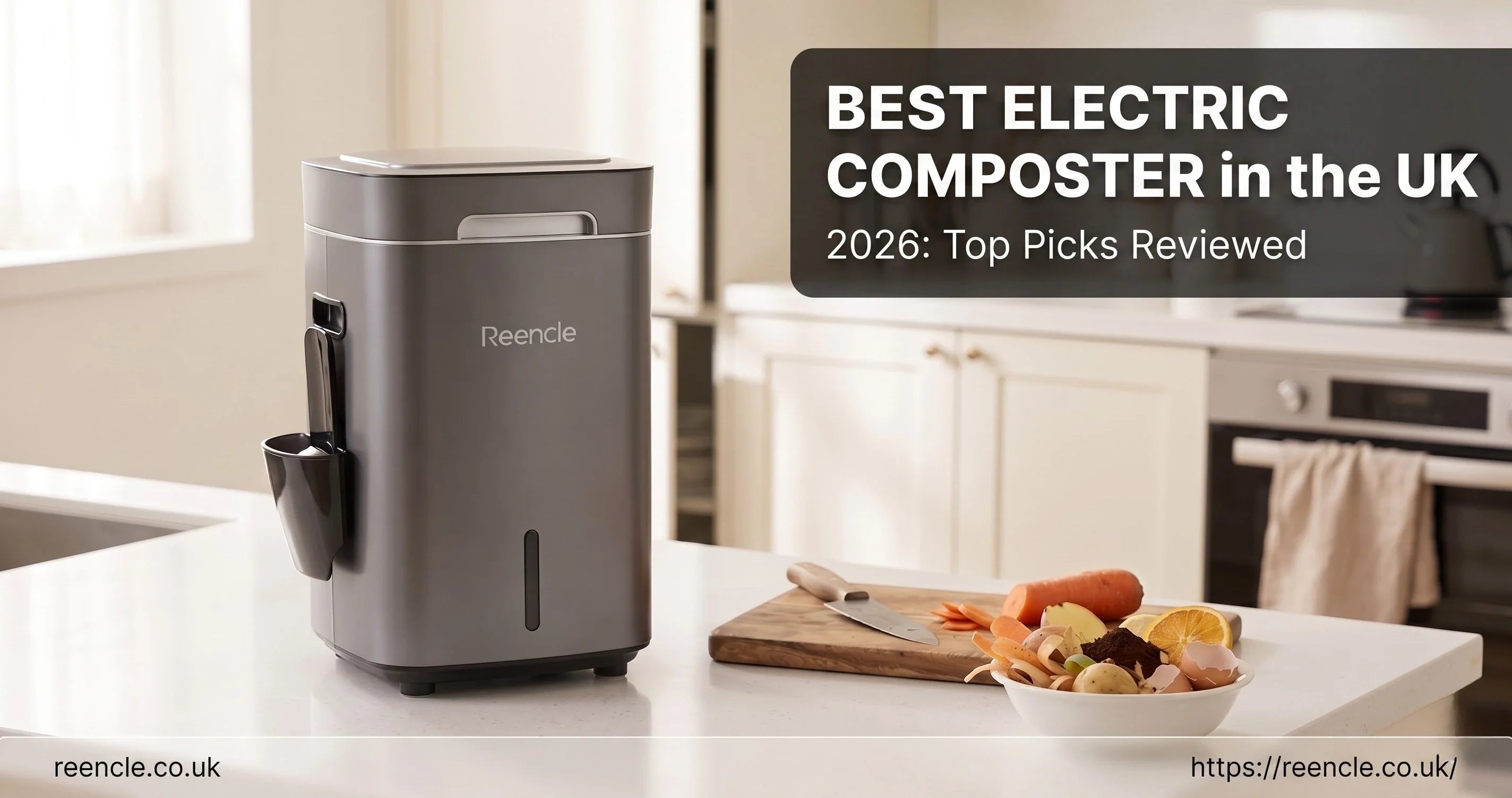

Leave a comment
This site is protected by hCaptcha and the hCaptcha Privacy Policy and Terms of Service apply.