
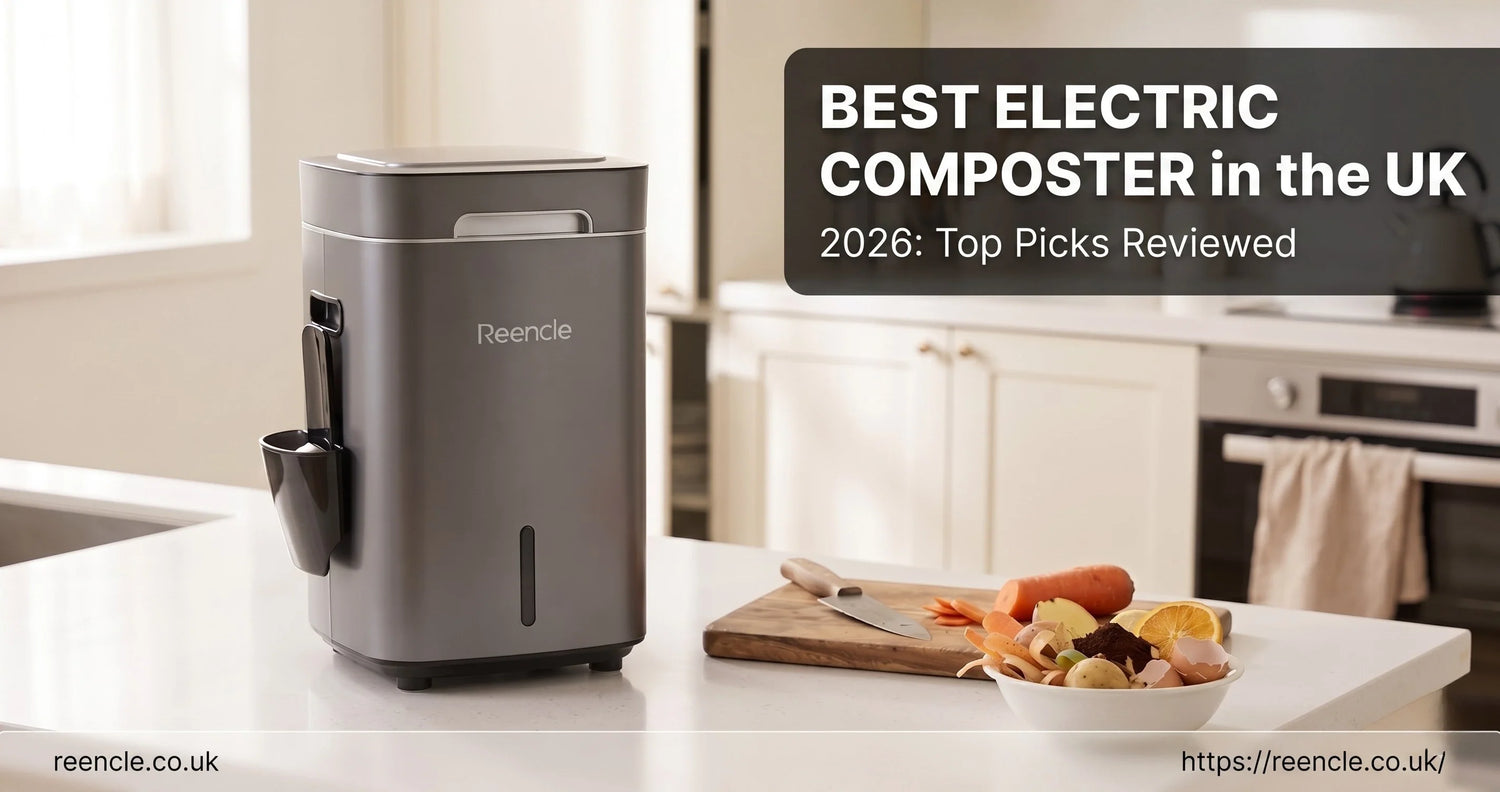
Best Electric Composter UK 2026: Top Picks Reviewed
Not all electric composters are the same. This guide covers the top models available in the UK right now, explains the real difference between true composters and dehydrators, and helps you work out which one is worth your money.
 The electric composter market in the UK has grown fast, and the marketing hasn't kept pace with the honesty. Several machines sold as "electric composters" are technically food dehydrators. They shrink waste volume, but they don't produce compost. That distinction matters quite a lot when you're spending between £250 and £450. This guide covers the four main models you can actually buy in the UK right now, comparing them on output quality, running costs, and everyday practicality.
Contents
True composters vs food dehydrators: what's the difference?
This is the most important thing to understand before you buy. It's also the thing most product listings quietly get wrong.
A food dehydrator uses heat and grinding blades to dry out food waste, reducing it to a fraction of its original volume. The output is sterile, dry flakes. It smells neutral and looks a bit like soil. But it hasn't undergone any biological decomposition at all. Put it straight onto a vegetable bed, and it can actually damage plants, drawing moisture from the soil as it rehydrates.
A true electric composter uses living microorganisms to break down food waste through biological decomposition. The output is biologically active. Mixed with soil after a short curing period, it genuinely improves growing conditions. It's the same process as an outdoor compost heap, just managed inside a countertop composter.
The Sage FoodCycler and Lomi (in standard mode) are dehydrators. Reencle and GEME use microbial processes and produce genuine compost-like output. Neither category is useless. They do different things. But the price gap between them is big enough that it's worth knowing which you're buying.
Reencle Prime
The Reencle Prime is the most established electric composter available in the UK. It's sold directly at reencle.co.uk and ships to UK addresses.
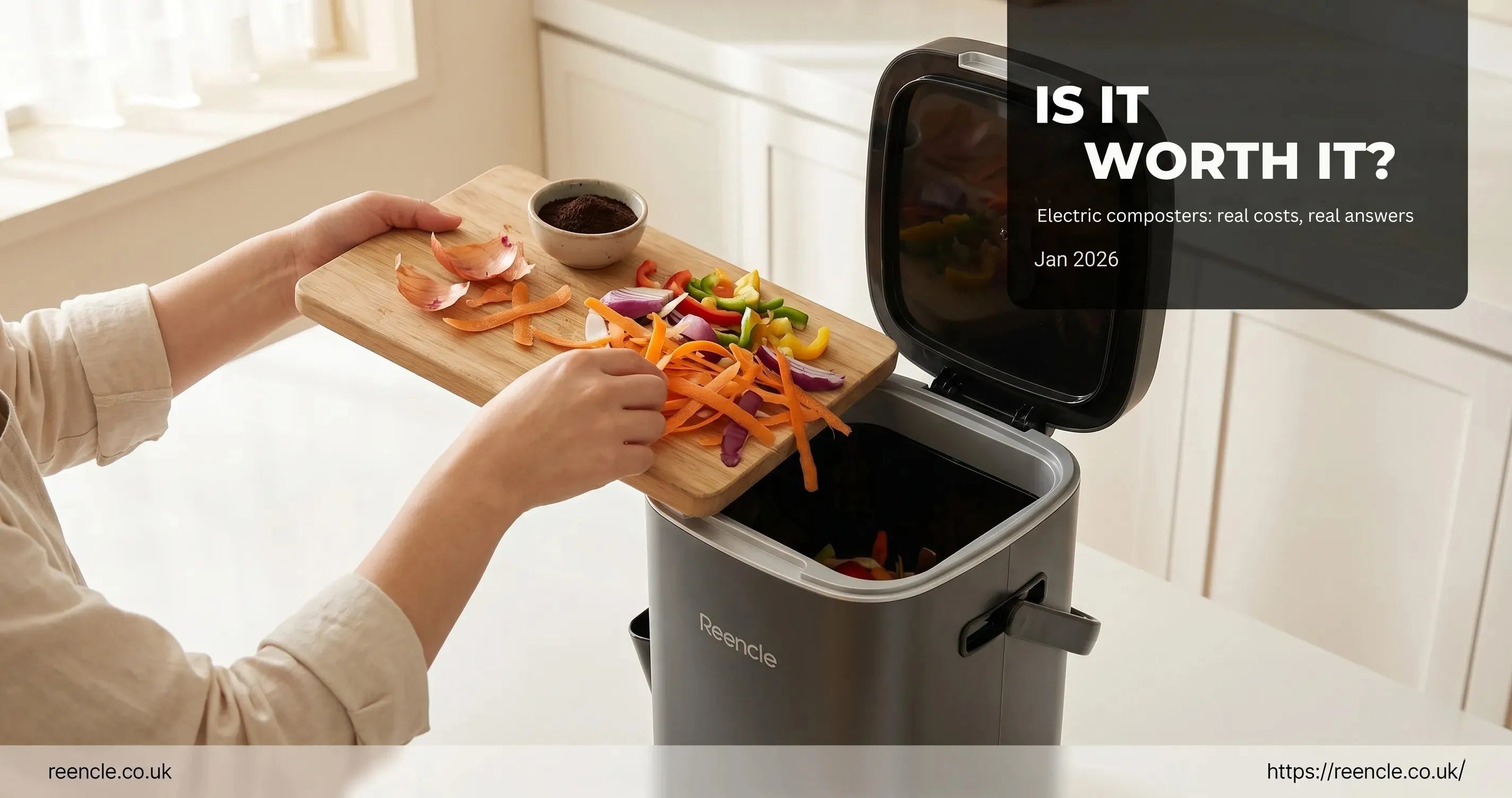
Inside the 14-litre chamber is a living microbial culture called ReencleMicrobe. You add food waste whenever you have it. The machine runs continuously, maintaining the temperature, humidity, and aeration the microbes need to break down organic matter. There are no batch cycles. You can add a banana peel at breakfast and cooked chicken at dinner without pausing anything.
Reencle doesn't call the output finished compost. They call it "garden fuel." It needs a short mixing period with the soil before use. Independent lab testing by Penn State University rated the output 2.2 to 2.4 on a compost stability scale, which puts it very close to mature compost. That's a meaningful gap from dried flakes.
- Capacity: 14 litres / up to 1kg per day
- Noise: Under 28dB (quieter than a library)
- Running cost: ~£4 to £6 per month (52W continuous)
- Filter: 3-layer carbon filter, lasts 9 to 12 months (~£30 to replace)
- Unit price: ~£425
The main downsides are the upfront cost and initial setup. You need to seed the machine with the microbial starter kit before it starts processing waste properly, which takes a few days. After that, maintenance is minimal.
GEME
GEME works on the same principle as Reencle. A proprietary microbial culture called Kobold breaks down food waste through biological decomposition rather than heat and grinding. The output is nutrient-rich compost, not dried flakes.
The difference is scale. The standard GEME has a 19-litre chamber and handles up to 5kg of waste per day. That's more than most UK households generate, which makes it a better fit for larger families or anyone producing serious food waste through batch cooking, meal prep, or a food business run from home.
- Capacity: 19 litres / up to 5kg per day
- Noise: Silent operation
- Filter: None required — built-in industrial deodorisation system
- Unit price: ~£400 to £500 (Amazon UK)
- Dimensions: 45.5cm wide x 66.5cm tall
The trade-off is size. GEME works better in a utility room, garage, or larder than on a kitchen worktop. It's heavier than the Reencle too, which matters if you'd ever need to move it.
Sage FoodCycler
The Sage FoodCycler is a dehydrator, not a true composter. That's not a criticism. It does exactly what it says, cleanly and reliably.
You fill the 2-litre bucket with food scraps, press one button, and wait 4 to 6 hours. The machine dries, grinds, and cools the waste into what Sage calls EcoChips. Volume drops by more than 80%. The output is sterile, odourless, and dry. It can go into a green waste caddy, be mixed into soil at a diluted ratio, or be added to an existing compost heap to finish breaking down naturally.
- Capacity: 2 litres per batch
- Cycle time: 4 to 6 hours
- Energy use: ~1kWh per cycle
- Unit price: ~£250 to £300
The 2-litre capacity is the main constraint. A household of four will fill it every one to two days. You also can't add waste mid-cycle. The machine runs its program and needs emptying before you start the next batch.
Lomi
Lomi is made by Canadian company Pela. It's available in the UK, though less widely stocked than the other options here. In standard mode it's a dehydrator. It also has a "Grow" mode that uses enzyme pods to produce output closer to finished compost.
The base machine holds 3 litres and runs in batch cycles of 3 to 20 hours, depending on the mode. Standard mode produces dried, ground waste in around 3 hours. Grow mode takes longer and produces more biologically useful output, though the pods add around £0.40 per cycle to your running costs.
- Capacity: 3 litres per batch
- Cycle time: 3 to 20 hours (mode dependent)
- Noise: Noticeable grinding during cycles
- Ongoing cost: ~£27/year filters + ~£0.40 per Grow mode pod
- Unit price: ~£400
Lomi fits households that prefer to process waste in distinct batches. If you cook in sessions and would rather run the machine overnight or while you're out, that rhythm works better here than with a continuous machine.
How to choose: capacity, output, and running costs
Three questions cut through the noise.
- How much food waste do you produce? A single person or couple generates roughly 0.5 to 1kg per day. A family of four is closer to 1.5 to 2kg. The FoodCycler (2L) works for one to two people. The Reencle Prime (14L, 1kg per day) suits two to four. GEME (19L, 5kg per day) is built for four or more.
- Do you want actual compost, or just waste reduction? If you have a garden, allotment, or houseplants and want usable output, go with Reencle or GEME. If you want to cut bin volume and kitchen smells without worrying about compost quality, the FoodCycler or Lomi do that at a lower cost.
- What are the real long-term running costs? Reencle costs roughly £4 to £6 a month in electricity plus one filter replacement per year at around £30. Lomi's Grow mode pods add around £0.40 per cycle. The FoodCycler uses approximately 1kWh per cycle and has lower consumable costs overall. GEME has no filter to replace.
Quick Reference
Electric composters compared at a glance
| Model | Type | Capacity | Cycle | Noise |
|---|---|---|---|---|
| Reencle Prime | Microbial | 14L / 1kg/day | Continuous | Under 28dB |
| GEME | Microbial | 19L / 5kg/day | Continuous | Silent |
| Sage FoodCycler | Dehydrator | 2L batch | 4 to 6 hrs | Quiet |
| Lomi | Dehydrator/enzyme | 3L batch | 3 to 20 hrs | Noisy |
| Model | Filter cost | Monthly running | Best for |
|---|---|---|---|
| Reencle Prime | ~£30/year | £4 to £6 | Real compost, 2 to 4 people |
| GEME | None | Low | Large households, no filters |
| Sage FoodCycler | Replaceable | Low | Small kitchens, flat-dwellers |
| Lomi | ~£27/yr + pods | Medium to high | Batch cycles, multiple modes |
The scale of UK household food waste
UK households throw away around 6.7 million tonnes of food every year. That's roughly 70% of all food waste generated in the country. The average household spends £470 on food that ends up in the bin. According to WRAP's 2025 Household Food Management Survey, 27% of UK households are classified as high food wasters, and eight in ten people believe they waste less than the average household.
Food waste collections are expanding in England following the Environment Act 2021, but rollout is patchy. Flats in some areas only began receiving collections from March 2026. Millions of households still have limited or no food waste collection available. For those households, an electric composter or food recycler is one of the few practical ways to keep waste out of the general bin.
The environmental cost adds up quickly too. UK food and drink waste generates an estimated 25 million tonnes of CO2-equivalent emissions each year, largely from methane released as organic waste breaks down in landfill. Dealing with it at home keeps it out of that chain entirely.
FAQ
Common Questions
Do electric composters actually make real compost?
Most do not. Machines like the Sage FoodCycler and Lomi (in standard mode) are dehydrators. They use heat and grinding to reduce food waste into dry, sterile flakes. That output is not biologically active compost. Reencle and GEME use living microbial cultures to break down waste through biological decomposition, producing an output much closer to genuine compost and suitable for use with plants after a short curing period.
Are electric composters worth the money in the UK?
It depends on what you want. If you have a garden and want usable compost without an outdoor bin, a microbial machine like the Reencle is worth the investment. If you just want to reduce kitchen bin odours and waste volume, a dehydrator like the Sage FoodCycler gets there at a lower price. Neither is a necessary purchase if you already have kerbside food waste collections and no use for the output.
Can I use an electric composter in a flat?
Yes. All four machines in this guide are designed for indoor countertop use. The Sage FoodCycler is the most compact option for small kitchens. The Reencle works well in flats where food waste collections are unavailable or unreliable, as it runs quietly and controls odours well. GEME is larger and better suited to a utility space than a tight kitchen.
Can electric composters handle meat and dairy?
The microbial machines (Reencle and GEME) handle meat, fish, cooked food, and dairy without problems. The Reencle's three-layer carbon filter manages odour from these inputs effectively. Dehydrators like the FoodCycler and Lomi can process small amounts of meat and dairy, but stronger smells during the cycle are more likely and some manufacturers recommend keeping those inputs limited.
How much does an electric composter cost to run per month in the UK?
Reencle draws around 52 watts per hour continuously, costing roughly £4 to £6 per month at current UK electricity rates. The Sage FoodCycler uses approximately 1kWh per cycle. Running one cycle every two days adds around £4 to £5 per month. Lomi's costs vary by mode. GEME has a higher continuous power draw but no filter replacement costs to add on top.
What do I do with the output if I don't have a garden?
Dehydrator output (FoodCycler, Lomi) can go into a green waste caddy, be sprinkled into a window box or houseplant pot at a diluted ratio, or be added to a neighbour's compost heap. Microbial output (Reencle, GEME) works well for houseplants, balcony containers, or growing bags. A small amount goes a long way when mixed into potting compost.
How often do filters need replacing in an electric composter?
The Reencle Prime filter lasts 9 to 12 months and costs around £30 to replace. The Sage FoodCycler's carbon filters typically need changing every 3 to 6 months depending on use. Lomi filters last around 3 months, with optional enzyme pods on top. GEME has no replaceable filter at all, using a built-in industrial-grade deodorisation system instead.
The bottom line
The best electric composter for your home comes down to three things: how much waste you generate, whether you want real compost or just volume reduction, and what the machine actually costs to run over time. For most UK households that want genuine compost output, the Reencle Prime is the standout choice.
And the scraps? Whichever model you're weighing up, the waste going in is the same: fruit peelings, vegetable offcuts, cooked leftovers, stale bread, meat trimmings, and dairy that didn't get used in time. Most of that ends up in the general bin by default, even in households that have food waste collections. A home composter handles all of it continuously, including the cooked food and meat that a traditional outdoor heap can't take. Add waste whenever you have it and the microbes do the rest.
See the Reencle Home Composter →

Leave a comment
This site is protected by hCaptcha and the hCaptcha Privacy Policy and Terms of Service apply.