
8 Egg Storage Tips That Keep Eggs Fresh
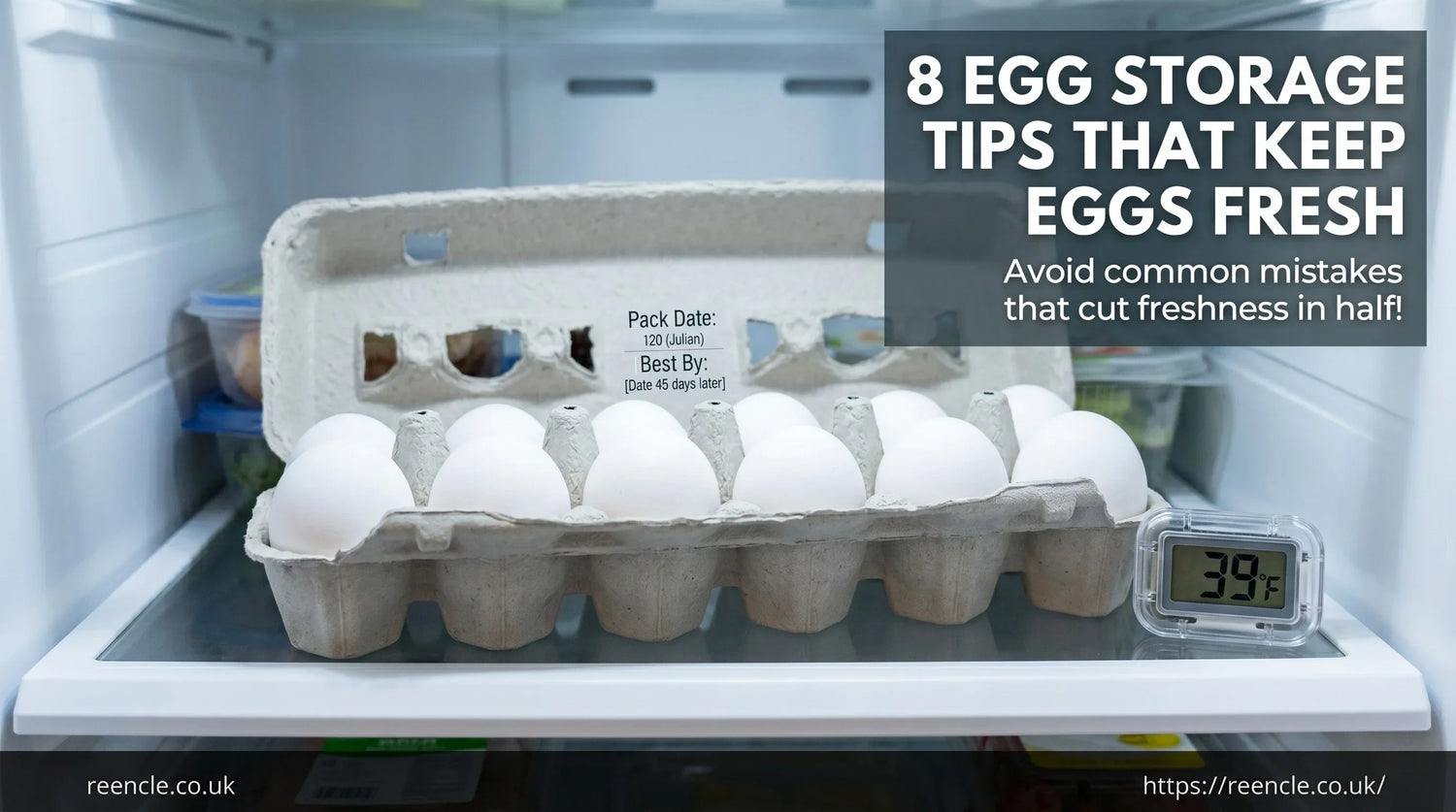
Raw eggs stay good for 3–5 weeks if you store them right. Most people make one or two small mistakes that cut that window down to two weeks. The difference usually comes down to where you put them in the fridge.
Keep Them in the Original Carton
Don't move eggs to your fridge door rack, even if there's a built-in compartment. The carton does more than hold eggs.
Eggshells are porous - hundreds of tiny pores run through each one. Left in open air, eggs pick up odors from everything nearby: onions, fish, garlic, last week's leftovers. The carton blocks most of that. It also keeps them from rolling around and cracking, and insulates them from small temperature swings.
The pack date is printed on the carton too, which matters more than people think (more on that below).

Store on the Coldest Back Shelf
The back of your main refrigerator shelf runs colder and more consistently than anywhere else. Put your eggs there and leave them.
What eggs need isn't the lowest possible temperature—it's stability. A steady 38–40°F is better than a spot that dips to 35°F when the fridge cycles and climbs to 45°F when the door opens. Temperature swings are what degrade eggs faster than anything.
A cheap fridge thermometer will tell you where that cold spot actually is. In most fridges, it's the back of the second or third shelf.
Never Store on the Door
This is the most common egg storage mistake, and refrigerator manufacturers don't help - many build egg compartments right into the door, apparently for aesthetics.
The door is the warmest zone in the fridge. It gets a blast of room-temperature air every time you open it. Eggs stored there experience constant temperature swings and spend a surprising amount of time above the ideal range. That alone can cost 1–2 weeks of freshness.
If your fridge has a door egg compartment, ignore it.
Keep the Pointy End Down
Store eggs with the large round end up and the pointy end facing down. The yolk naturally floats toward the wider end, and this positioning keeps it centred.
The goal is to keep the yolk away from the air cell, which sits at the pointy end. A centered yolk is less likely to push through the membrane and break into the white during storage. Commercial egg operations use this orientation because it measurably extends shelf life.

Set Your Fridge to 40°F or Below
Eggs need to stay at 40°F (4°C) or below. Most people assume their fridge is already there—most fridges aren't.
Pick up a refrigerator thermometer for $5–10. Set it on the shelf where you store eggs, leave it 24 hours, and check. If it reads above 42°F, dial the fridge colder and test again. Eggs at 45°F degrade noticeably faster than eggs at 40°F.
If you can't get below 42°F even on the coldest setting, the fridge is losing efficiency and probably needs servicing.
Learn to Read the Julian Date
Forget the "best by" date. The number that actually matters is the Julian date.
Look for a three-digit number on the carton - somewhere between 001 and 365 - representing the day the eggs were packed. Day 001 is January 1. Day 032 is February 1. Find it and use it.
Under USDA rules, eggs are safe for up to 45 days from that pack date. So if the carton shows day 010 and today is day 045, you have 10 days left. The "sell by" date is a retail inventory tool. It's not a safety deadline, and eggs remain perfectly fine past it as long as they're within 45 days of the pack date.
Use the Float Test for Questionable Eggs
If you're not sure how old an egg is, fill a bowl with cold water and drop it in.
- Sinks flat: Fresh. Use it normally.
- Sinks but stands upright: Older but still fine. Use it within a few days.
- Floats: Throw it out.
As eggs age, moisture escapes through the shell and the air cell inside grows larger. A floating egg has lost enough moisture that it's buoyant - it's past its prime.
One caveat: the float test measures age, not bacterial contamination. It won't detect Salmonella. Cook eggs to 160°F (71°C) regardless of how they floated.

Store Hard-Boiled Eggs in Water
Hard-boiled eggs last about one week in the fridge- much less than raw. Cooking removes the shell's natural protective coating, leaving the egg more vulnerable to bacteria and moisture loss.
For peeled hard-boiled eggs, keep them submerged in cold water in a covered container and change the water every day. That keeps the surface from drying out and limits odor pickup.
If the shells are still on, store them on the cold back shelf like raw eggs and leave the shell in place until you're ready to eat them -it still offers some protection. Mark unpeeled hard-boiled eggs with a permanent marker so you don't accidentally crack a raw one into the pan expecting it to be cooked.
What the Pros Know
Commercial hatcheries obsess over temperature because they deal in scale—a 5°F swing affects how many eggs are still fresh at day 30. What they've found is that consistency matters more than chasing the perfect temperature. An egg stored at a steady 38°F outlasts one stored at 35°F most of the time but 50°F when someone leaves the fridge open too long.
For home cooks, the lesson is simple: get your fridge to 40°F, leave the dial alone, and stop fiddling. Consistency does more for shelf life than any optimization trick.
The Bottom Line
Eggs last 3–5 weeks with minimal effort: original carton, back of the fridge, 40°F or below, pointy end down, never on the door. Check the Julian date when you buy them and use the float test when you're not sure. Hard-boiled eggs are a different situation—one week, stored in water.
Start here: Check your fridge temperature today. That one adjustment does more than anything else on this list.


Leave a comment
This site is protected by hCaptcha and the hCaptcha Privacy Policy and Terms of Service apply.