
Reencle Prime vs. Reencle Gravity Pro: Which One Is Right for You?

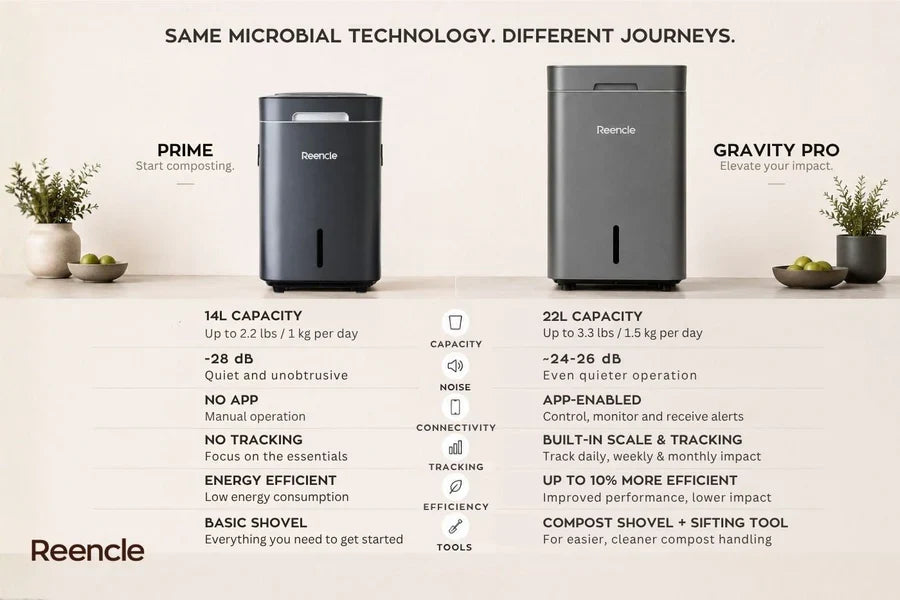
Side-by-side comparison of Reencle Prime and Gravity Pro composters showing capacity, noise level, app connectivity, tracking, and included tools.
Buying Guide

Reencle Prime vs. Reencle Gravity Pro: Which One Is Right for You?


Both machines run the same live microbial composting technology. The right one for your kitchen comes down to household size, food waste volume, and whether app control matters to you.

By Neuza Carvalho · 28 May 2026

Quick answer: both models use the same live microbial culture to produce real compost. The differences are size and smart features. Reencle Prime suits smaller households of one to three people with lighter food waste. Reencle Gravity Pro suits families of four or more who want higher capacity and full app connectivity. If the Prime model genuinely fits your household, there's no reason to buy up.

Both machines are built around the same composting principle, so this isn't a case of one model being "better" than the other. It's a question of matching capacity, footprint, and features to your actual household. This guide walks through where the two models are identical, where they genuinely differ, and which situations point clearly to one model over the other.

Every spec below comes directly from Reencle's own published product data for the UK. Where a figure is Reencle's own measurement rather than independently audited, we say so rather than dress it up as third-party research.

Shared Technology

Same Core Technology: What Both Models Share

Before looking at the differences, it helps to understand what makes both Reencle models fundamentally the same, and why that matters for your decision.

Both the Prime and the Gravity Pro use a live microbial culture system: a colony of naturally occurring microorganisms that biologically breaks down food waste through active decomposition, the same process that happens on a forest floor, scaled down to a countertop appliance.

This isn't dehydration. Dehydration-based food recyclers remove moisture from food scraps, shrinking them into a dry powder that is still waste; it hasn't undergone biological transformation. Reencle's process is genuine composting: the microorganisms consume organic matter and convert it into a humus-like material.

  • Live microbial culture: the same starter culture, maintained continuously
  • Real composting, not drying: biological decomposition, not heat-based moisture removal
  • 30-day curing principle: output from either model benefits from a 30-day curing period before direct application to sensitive plants or seedlings
  • Accepts meat and dairy: unlike traditional compost bins, both models handle the full range of kitchen scraps
  • Continuous-use design: you add scraps daily and the machine works around the clock
  • Trusted worldwide: in 300,000+ homes across 19 countries
Key takeaway: The choice between models comes down to your household's food waste volume, your kitchen's worktop space, your budget, and whether app connectivity matters to you.

Quick Reference

Reencle Prime vs Gravity Pro at a Glance


Spec Reencle Prime Reencle Gravity Pro
Best for household size 1-3 people 4+ people
Daily food waste capacity Up to 1kg/day Up to 1.5kg/day
Internal volume 14L 22L
Countertop footprint More compact Larger footprint
App connectivity Not available Monitor & control from anywhere
Price point Lower Higher
CO2 offset (annual estimate) ~0.39 tonnes/year Higher, proportional to volume
Accepted inputs Meat, dairy, veg, fruit, cooked food Meat, dairy, veg, fruit, cooked food
Curing period 30 days recommended 30 days recommended
Odour control Built-in filter Built-in filter
Ideal kitchen setting Apartment, small kitchen, minimalist counter Family kitchen, active garden, smart home users
Buyer Fit

Who Should Choose Reencle Prime

Reencle Prime is the right choice if your situation matches most of the following:

Your household is 1-3 people. The Prime model's daily capacity aligns with the food waste a smaller household realistically generates. You won't be underserving the machine or constantly hitting its limits.

You live in an apartment or have a compact kitchen. The smaller footprint fits more naturally on a crowded counter. If counter space is at a premium, the Prime is the practical call.

Your food waste is lighter and less varied. If your household mainly generates vegetable peelings, fruit scraps, and coffee grounds, rather than large volumes of meat scraps or cooked meals, the Prime handles your load comfortably.

You're new to composting. If you're just starting to reduce food waste at home and aren't yet sure how much output you'll use, starting with the Prime is a sensible, lower-commitment entry point.

You don't have a large garden. The Prime still produces real compost, but in quantities suited to a few houseplants or a small balcony planter box.

Key takeaway: If most of these match your household, Prime is the sensible, lower-cost choice. It isn't under-specced for what you'll actually put through it.
Buyer Fit

Who Should Choose Reencle Gravity Pro

Reencle Gravity Pro is the right choice if your situation matches most of the following:

Your household is 4 or more people. More people means more food waste. The Gravity Pro's higher daily capacity keeps up with your household's output without overflow or slowdown.

You generate heavy or varied food waste. Families that regularly cook meat-heavy meals, prepare large quantities of food, or generate significant amounts of cooked leftovers benefit from the Gravity Pro's larger processing volume.

You have an active garden. The Gravity Pro produces compost at a rate that meaningfully supplies a vegetable garden or raised beds. If you garden seriously, the higher processing capacity means more soil amendment for your beds each season.

Long-term cost-per-use matters to you. A higher initial investment, spread across years of continuous use in a busy household, often makes the Gravity Pro the more economical choice per kilo of food waste composted.

You want to monitor and control your composter remotely. The Gravity Pro connects to your phone, so you can check in, adjust settings, and track progress from anywhere without being in the kitchen.

You like tracking your impact. The app lets you follow your daily, weekly, and monthly contribution to healthier soil, turning composting into a measurable habit.

Key takeaway: If most of these match your household, the extra cost of Gravity Pro buys capacity and control you'll actually use, not just capacity for its own sake.
Did You Know

The CO2 Impact Picture

The published CO2 offset figure for Reencle, 0.39 tonnes per year, is Reencle's own figure for the Prime model. It's based on the estimated greenhouse gas emissions avoided by diverting food waste from landfill, where it would otherwise decompose anaerobically and release methane.

The Gravity Pro, processing a larger volume of food waste, produces a proportionally higher offset, though Reencle hasn't published a separate figure specifically for the Gravity Pro.

For context, 0.39 tonnes of CO2 equivalent per year is roughly comparable to eliminating several hundred miles of car travel annually. Across the 300,000+ homes using Reencle worldwide, the cumulative impact adds up.

Sources: Reencle's own published estimate. Not independently audited; treat it as a directional guide to the environmental case rather than a precise per-household guarantee.

FAQ

Common Questions


How many people is Reencle Prime designed for?

Reencle Prime is designed for households of 1-3 people. Its daily capacity aligns with the typical food waste output of a smaller household. If your household regularly generates more than this, the Gravity Pro will serve you better.

Can I upgrade later if I start with the Prime model?

Yes. If you start with Reencle Prime and later find your household has grown or your composting needs have increased, you can move up to the Gravity Pro. The microbial culture in both units operates the same way, and Reencle's customer support can advise on the smoothest path to upgrade.

Is the Gravity Pro worth the extra cost?

For households of 4 or more, yes. The Gravity Pro's higher capacity means it operates efficiently at the volume you actually produce. For a 1-2 person household, the Gravity Pro is more machine than you need, and the Prime will serve you just as well at a lower price point.

Do both models accept meat and dairy?

Yes. Both the Prime and the Gravity Pro accept the full range of kitchen food waste, including meat, fish, dairy, cooked food, and oily scraps. This is one of the key advantages of Reencle's live microbial composting system over traditional garden compost bins.

Which model has better odour control?

Both models use the same odour-control technology: a built-in filter system that manages the gases produced during biological decomposition. Odour control quality is equivalent between the two models.

🌱

The bottom line

Both models produce real compost from the same live microbial culture. Choose Prime for a smaller household, Gravity Pro for a bigger one with heavier waste and app control.

And the scraps? Whichever model you choose, the same scraps go in: carrot and potato peelings, coffee grounds, banana skins, leftover rice, and meat trimmings traditional compost heaps can't handle. That's the real test of either machine, not the spec sheet but the food waste sitting in your kitchen bin right now. A Prime or Gravity Pro turns those scraps into usable compost within days instead of a landfill statistic, which is the whole point of buying one in the first place.


Reading next

Person's hands pressing seeds into dark soil in a garden bed with kale seedlings and a trowel visible in the background on a bright late-summer day.
Sealed honey jar on a kitchen shelf with thermometer — The Complete Honey Shelf Life Guide by Reencle

Leave a comment

This site is protected by hCaptcha and the hCaptcha Privacy Policy and Terms of Service apply.