
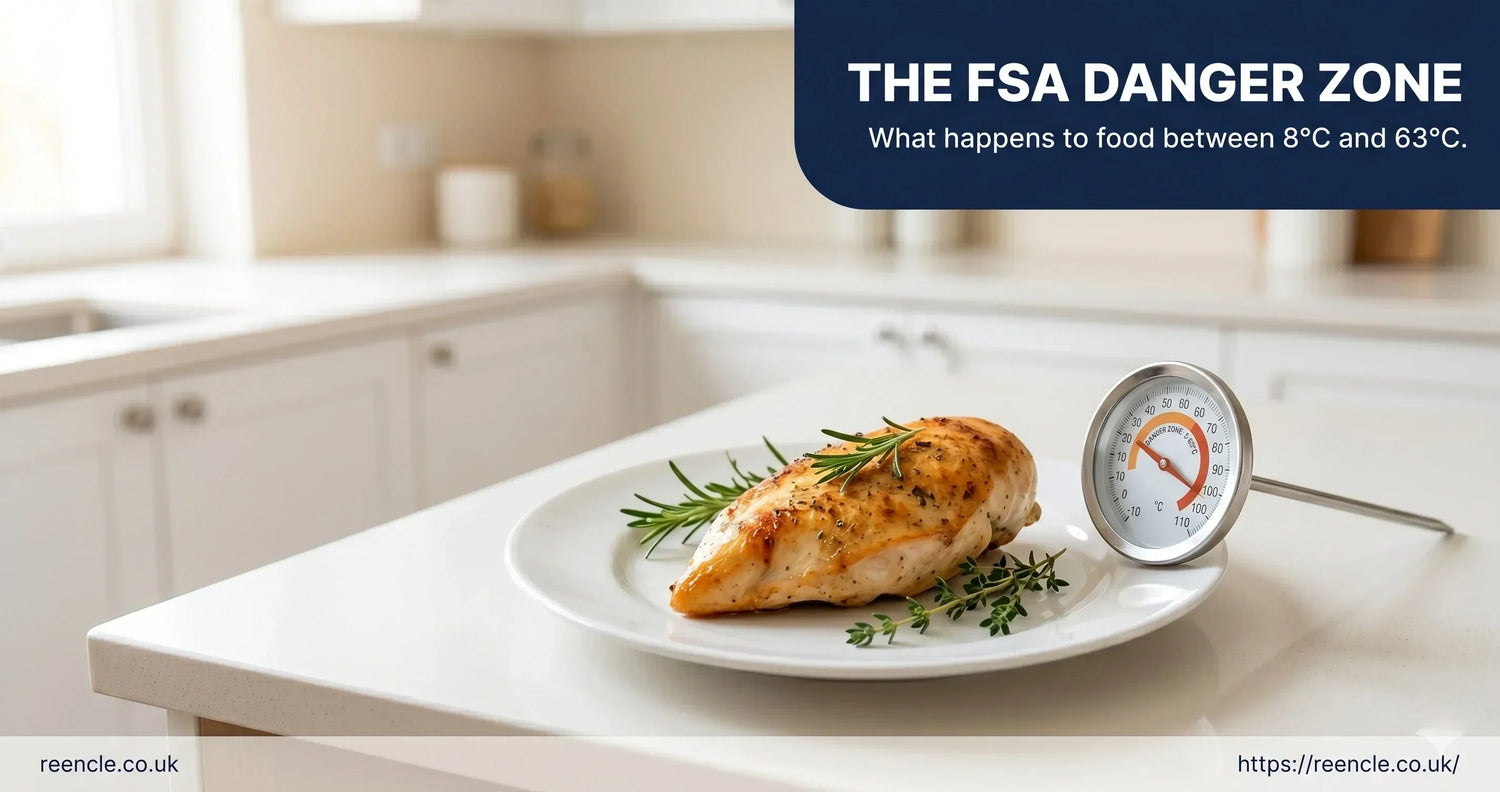
The FSA Danger Zone Explained
Between 8°C and 63°C, bacteria can double every 20 minutes. Understanding why this temperature band matters explains why the 2-hour rule exists — and why reheating food that's been left out too long doesn't always fix the problem.
The temperature danger zone sounds like something from a spy thriller, but it's actually about food safety. Between 8°C and 63°C, bacteria thrive — fast. At these temperatures, some bacteria can double their population every 20 minutes. Understanding why this temperature band matters and what's happening at the cellular level explains why the 2-hour rule exists, and why reheating food that's been left out too long doesn't always fix the problem.
Contents
What the Danger Zone Is (And Why That Temperature Range)
The Food Standards Agency defines the danger zone as 8°C to 63°C. Below 8°C, bacterial growth slows dramatically. Above 63°C, most harmful bacteria are killed or stopped from growing. The space in between — that's where the problem lives.
The temperature matters because it determines how fast bacteria multiply. At 5°C (the upper end of a well-set fridge), bacteria grow so slowly that food stays safe for days. At 63°C and above, the heat kills most pathogens. In between, food becomes a bacterial breeding ground.
The Bacteria Involved
- Staphylococcus aureus — naturally on human skin, in noses, in throats. Transfers easily during food prep and produces heat-stable toxins that survive cooking.
- Salmonella — survives if food wasn't cooked to the right temperature initially, and spreads through cross-contamination after cooking. Reproduces rapidly in the danger zone.
-
Clostridium perfringens — spores survive cooking. As food cools slowly, those spores germinate and multiply. One reason professional kitchens are strict about cooling cooked food quickly.

Why the Maths Matters
Start with one bacterial cell per gram. At a doubling rate of every 20 minutes:
- After 2 hoursover 4,000 cells per gram
- After 4 hoursover 65,000 cells per gram
- After 6 hoursover 1 million cells per gram
The dosage required to cause illness varies by organism, but these numbers show why time in the danger zone isn't a linear risk — it's exponential. An extra hour isn't just "a bit more risk." It's orders of magnitude more bacteria.
Why Reheating Doesn't Always Work
This is where most people get it wrong. Heat kills bacteria, right? So reheating should fix it. Not always.
When Staphylococcus aureus multiplies at room temperature, it produces enterotoxins — proteins that cause food poisoning. These toxins are heat-stable. Boiling them, baking them, microwaving them at full power doesn't destroy them. A chicken breast that sat out for 4 hours and then got reheated to 70°C is bacterium-free but still toxic.
Same issue with Bacillus cereus. It makes heat-stable toxins that survive the cooking process. The bacteria are gone, but the toxins remain. The FSA also recommends reheating food only once — repeatedly changing temperatures gives bacteria more opportunities to multiply.
When the Clock Starts — And Why It Matters
The 2-hour timer doesn't start when you sit down to eat. It begins the moment food leaves safe temperature control — whether that's when it comes out of the oven, off the hob, or out of the fridge for serving.
- It's cumulative. If chicken sat out for 45 minutes at dinner, went back in the fridge, then came out again for 30 minutes the next day, that's 75 minutes total. The clock doesn't reset just because the food was refrigerated in between.
- Hot-held food has a tighter window. For food being kept warm — at a buffet, on a warming tray, or in a slow cooker — the FSA advises no longer than 1 hour. Cooling gives you 2 hours to reach below 8°C. Hot holding gives you 1 hour before risk increases meaningfully.
- Room temperature isn't about the air. A cooked chicken breast pulled from the fridge sits around 5°C. In a 20°C kitchen, it warms gradually. By the 2-hour mark, it's typically well into the danger zone.
What You Actually See (Or Don't See)
Food left too long in the danger zone often looks and smells fine. Bacteria that produce toxins don't necessarily create obvious spoilage signs. You can't taste or smell the difference between safe and unsafe.
- Sour or off smell: Bacterial spoilage. Discard immediately.
- Slimy or tacky texture: Bacterial growth. Discard immediately.
- Unusual discolouration: Advanced decay. Discard.
- Visible mould: Discard the entire portion — not just the affected area.
Hot Holding and Cold Holding at Events
At gatherings, keeping food safe requires active temperature control throughout service — not just at the start.
- Hot holding — maintain food at 63°C or above using chafing dishes, slow cookers on warm, or an oven set low. Use a food thermometer to check actual food temperature, not the equipment reading. Don't keep food hot-held for more than 1 hour.
- Cold holding — keep food on ice, at or below 8°C (ideally 5°C). Nestle serving dishes in ice and replace it as it melts.
Cooking Temperatures: England vs Scotland
The FSA recommends cooking food to a core temperature of 70°C for 2 minutes as the standard for England, Wales, and Northern Ireland. Scotland's guidance is slightly stricter at 82°C. The principle is the same — killing harmful bacteria — but if you're operating in Scotland or cooking for a Scottish food business, the higher threshold applies.
- England, Wales & NI70°C for 2 minutes minimum
- Scotland82°C
- 60°C (lower temp method)must hold for 45 minutes
Why This Matters Beyond Chicken
The danger zone applies to all cooked foods — chicken just gets the attention because Salmonella and Staphylococcus are so strongly associated with poultry. Cooked beef, fish, vegetables, rice, and anything protein-rich faces the same bacterial growth dynamics between 8°C and 63°C.
Campylobacter infections in England hit a decade high in 2024, reaching 70,352 reported cases — a 17.1% rise on the previous year. Salmonella reached the same milestone, climbing to 10,388 cases. These aren't rare edge cases.
- Campylobacter (2024): 70,352 cases — highest in a decade, up 17.1% from 2023
- Salmonella (2024): 10,388 cases — also a decade high, up 17.1% from 2023
When the Failure Isn't in the Cooking
Clostridium perfringens — one of the three pathogens covered above — is behind some of the most preventable food poisoning cases in UK professional kitchens. It shows up repeatedly in care home settings, where bulk cooking is common: large trays of minced beef, braised meat, or casseroles prepared in advance and left to cool slowly. The spores survive the cooking process. If the food lingers in the 8°C–63°C danger zone during cooling, those spores germinate and multiply fast.
The consequences are documented. A care home operator was fined £20,000 after 15 residents — aged 73 to 100 — developed C. perfringens food poisoning from improperly handled minced beef. A separate operator faced a £14,415 fine after six residents were affected in a similar incident.
Quick Reference
Temperature Rules at a Glance

FAQ
Common Questions
The bottom line
Keep food below 8°C or above 63°C. The moment it leaves that safe range, the clock is running — and it doesn't reset. Two hours is your maximum window for most situations. One hour for hot-held food. Reheat once, to temperature, and never rely on your senses to tell you if something is safe.
And the food scraps? Trimmings, past-their-prime leftovers, and food waste don't have to go straight in the bin. A food waste composter turns them into something useful instead.
Explore the Reencle Composter →

Leave a comment
This site is protected by hCaptcha and the hCaptcha Privacy Policy and Terms of Service apply.